

Signs You Are Ready for a Virtual Assistant (and Signs You Are Not)

The Real Signs you are Ready for a Virtual Assistant
Almost every article on this subject tells you that feeling overwhelmed means it is time to hire, which is comforting and mostly wrong. Overwhelm is a symptom with several causes, and only one of them is capacity. It can just as easily mean unclear priorities, work you should be declining, or a process so undefined that everything takes three times longer than it should. An assistant fixes none of those.
The useful signal is more specific than being busy. It is whether there is identifiable, repeatable work that someone else could do to your standard, and whether you can describe that standard well enough for another person to hit it. Those two conditions, not the feeling, decide whether the hire works.
Five Signs you are Ready to Delegate to a Virtual Assistant
Owners who delegate successfully tend to recognise themselves in a fairly narrow set of circumstances. Notice that each of these is about the shape of the work, not about how you feel on a Thursday afternoon.
- The same task appears every week and you could write down how to do it.
- You routinely push revenue work aside to clear admin.
- Something with a deadline has slipped, or nearly slipped, in the last quarter.
- You have turned down an opportunity because there was no room in the week.
- Work happens in the evening that could have happened at any time of day.
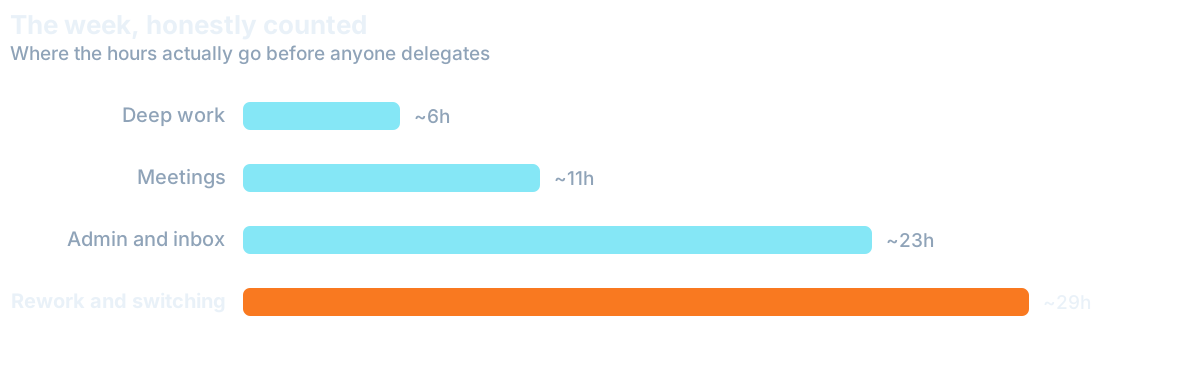
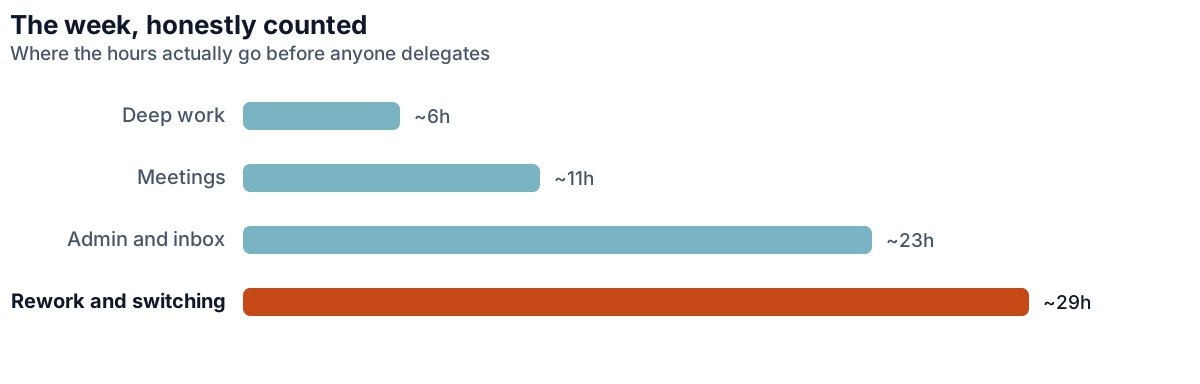
Notice what is absent from that list: revenue, headcount and how long you have been trading. Owners often assume there is a size at which delegation becomes appropriate, and there is not. A solo operator with ten hours of repeatable admin is readier than a larger business whose work is all judgement calls.
Three Signs you are not Ready to Hire yet
This is the part most articles leave out, because it argues against the hire. There are conditions where bringing someone in reliably increases your workload rather than reducing it, at least for the first several weeks, and knowing them saves a lot of disappointment.
The first is volatility: if you cannot predict what next month looks like, you cannot write a scope, and an assistant with no scope generates questions instead of absorbing work. The second is when the tasks eating your time are decisions rather than execution. Decisions do not delegate, and dressing them up as tasks produces a person waiting on you all day. The third is when you have no capacity at all to onboard, because every engagement costs more time than it saves in the opening fortnight without exception.
None of these means never. They mean the constraint is somewhere else right now, and hiring will not move it.
A One-Week Test that Settles it
For one week, write down every task you do that takes more than ten minutes, and mark each one with whether it needed your specific judgement, your relationships, or your licence. Do not tidy the list or interpret it as you go. The value is in it being honest rather than flattering.
At the end of the week, add up the unmarked items. If that total is under about five hours, your problem is probably prioritisation rather than capacity, and a hire will not touch it. If it is more than ten, you have a role sitting in your calendar and the only question left is who fills it, which is where finding and vetting the right assistant comes in. Between the two, start part-time and expand from evidence.
Look at what those unmarked items are as well as how many hours they add up to. If most of them are the same few steps repeated, with no calls and no judgement in them, the answer may not be a person, or not only a person. That kind of work can go to a Digital Employee, a virtual assistant, or both on the same job, and our comparison of the three ways to hire shows which fits which kind of list.
Run that week honestly even if the answer is inconvenient. Owners frequently discover that the largest block is decisions they have been deferring: meetings that should have been declined, approvals sitting unmade, a conversation postponed for a month. No assistant clears that block. If you keep stalling for reasons like these, read why founders struggle to delegate. It is a better problem to find in a notebook than three months into an engagement.
What to Delegate to a Virtual Assistant First
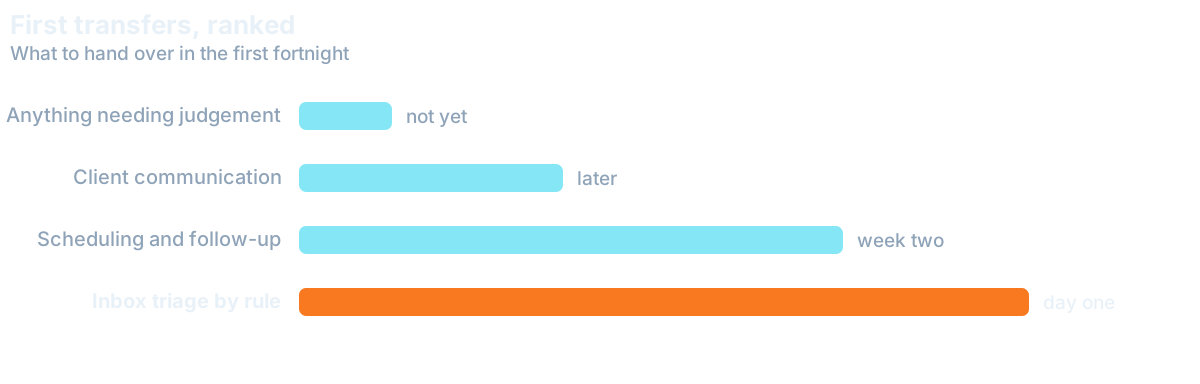
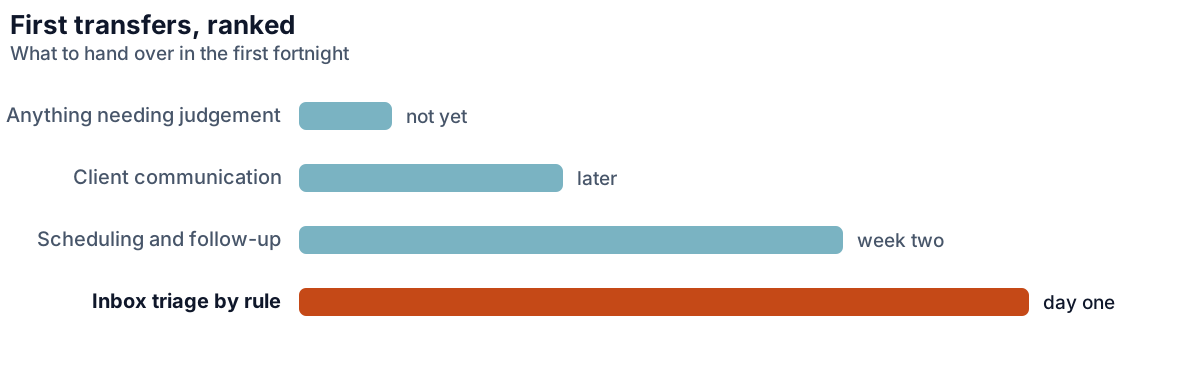
Start with work that is repeatable, low-risk and easy to check, which is rarely the work that annoys you most. The instinct is to hand over whatever you hate, but the tasks you hate often have the least defined process, which makes them a poor first transfer. Choose something dull, frequent and verifiable instead. Our full guide to what to delegate first walks through the order.
Inbox triage, calendar coordination, data entry, follow-up sequences and document preparation all qualify, and most of it is the core work of an administrative assistant. The point of the first transfer is to build the working relationship and prove the handover on something where a mistake costs almost nothing. The harder work moves in month two, once you both know how the other operates.
Some owners hire for the wrong reason: because a peer did, or because the business feels like it should have staff by now. That produces a role built around status rather than work, and it is the most reliable way to end up managing someone with nothing definite to do. The test is whether you can name the tasks before you name the hire.
What Changes after you Hire, and When?
The first two weeks cost you time rather than saving it, and owners who are not warned frequently conclude the arrangement is failing while it is working normally. You are converting knowledge that lives in your head into instructions someone else can follow, and that conversion is work regardless of who you hired.
Somewhere in the second month the curve turns, and the change is usually qualitative rather than quantitative. A whole category of interruption stops reaching you at all. Owners tend to describe it as the day they stopped checking something, rather than the day their calendar cleared, which is a more accurate picture of what delegation buys.
Want this handled for you?
We map the work eating your week and match a skilled specialist, typically in 7-14 days.