

What to Delegate First: A Practical Order of Operations

What to Delegate First: Pick the Right Task, not the Worst One
When owners decide what to delegate first, the instinct is to hand over the task they hate the most. That is almost always the wrong opening move. The work you dislike usually has the least defined process, which is often why you dislike it, and that makes it the hardest job to hand off cleanly. It tends to bounce straight back to you, worse than it left.
Your first hand-off does more than remove work. It sets how you and your new assistant will work together. Give away something messy and high-stakes and you test the relationship before it exists. Give away something simple and easy to check and you build the basics on a task where a mistake is cheap and the fix is easy to explain. If you are still weighing whether the time is right, our guide to the signs you are ready for a virtual assistant is the place to start.
The first task should also be quick to check. Work that takes you twenty minutes to review defeats the purpose in the early weeks, when you are checking everything. Choose tasks whose result is clearly right or clearly wrong at a glance. That keeps your supervision time low, so the help feels like relief rather than a second job.
How to Decide What to Delegate to a Virtual Assistant
You do not need a long list to choose well. You need two simple tests. Score each task on these two questions and the right order to delegate becomes obvious.
Frequency and Risk: The Two Tests that Set your Delegation Order
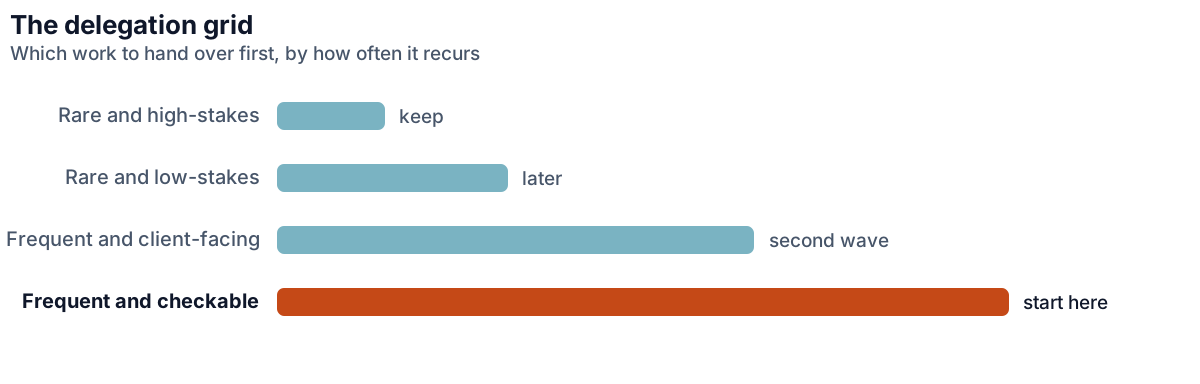
The first test is frequency: how often does this task come up, and how much time does handing it off save every week. The second test is risk: if it is done wrong, does a client see it, does money move, or does a deadline slip. High-frequency, low-risk work is where you start, because it saves time fast and costs little to get wrong. High-frequency, high-risk work comes second, once the process is written down and trust is built. Low-frequency, high-risk work is often not worth delegating at all, and low-frequency, low-risk work can wait.
The First Tasks to Delegate: Frequent, Low-Risk, Easy to Check
The best first tasks happen often, follow a clear pattern, and can be checked in seconds. Strong examples include inbox triage by rules you set, calendar coordination, data entry and CRM hygiene, standard follow-up sequences, document preparation from templates, and meeting notes with action points. Most of this is the core work of an administrative assistant, and it is the safest place to begin.
Why Boring, Repeatable Tasks are the Best First Delegation?
None of that work is glamorous. Each task is frequent enough that removing it changes your week within days, and low-stakes enough that early mistakes cost you a quick correction rather than a client. By the time this first wave runs without you, you have a working relationship, a written standard, and real evidence of how your assistant handles feedback, which is what the next, bigger hand-off runs on.
Some of that first wave does not need a person at all. A task with a clear trigger and a clear finished state, such as moving web-form entries into your CRM or sending the standard follow-up after a call, is the kind of work a Digital Employee runs: AI built for one role's repeatable work inside the tools you already use. It starts supervised, and once it delivers consistent results it runs on its own, with your approval kept on the steps you choose. The same two tests apply, and a task that is frequent, low-risk and fully rule-bound is a candidate for either.
The Second Wave: Client-Facing Work to Hand off Next
Once the basics are proven, you can hand over higher-value work: client communication within set limits, vendor coordination, scheduling that involves negotiation, first-line customer support, and reporting that someone will act on. This is often the work of an executive assistant, and it changes how much your business can carry.
Set Clear Boundaries before you Delegate High-Stakes Work
Every second-wave task needs a clear boundary before it moves, not after. Decide three things for each one: what your assistant may decide alone, what needs your sign-off, and what must never go out without you. When this goes wrong, it is usually a capable assistant making a reasonable call that you would have made differently, in a situation nobody had defined.
Write Boundaries as Money and Time, not Vague Rules
The clearest boundaries use numbers. An approval limit of a set dollar amount is easy to follow; "use your judgement on small things" is not. A rule that anything touching a contract comes to you is easy to check; "be careful with important clients" is not. Boundaries fail when they force your assistant to guess where your line sits, and clear numbers remove the guessing.
What you should Never Delegate?
Some work is yours to keep, and being clear about it protects both sides. Anything that needs your licence, your legal accountability, or your personal relationship with a specific client stays with you. So does strategy. Deciding what the business does next is not a task, and treating it like one produces plans that nobody owns.
The Twice-a-Year Test for Rare, One-Off Tasks
One more category stays with you: work that is faster to do than to explain, and that comes up too rarely to ever repay the training. Handing it off is a net loss. The test is simple. If explaining the task takes longer than doing it, and it happens only about twice a year, keep it.


Document Each Task as you Delegate it
One habit makes the whole sequence faster: write the process down as you hand it over, not before. Waiting for the perfect written procedure usually means never starting. Instead, walk your assistant through the task once while they write the steps down. You get a usable procedure and a trained person in the same hour. For a format your assistant will follow, see our guide on how to write an SOP. The written version is often better than yours, because it comes from someone who did not already know the answers.
Why the Order of Delegation Matters More than the List?
Most delegation advice hands you a list of tasks, which is the least useful part. Two owners with the same list can get opposite results, because each successful hand-off makes the next one cheaper. The relationship is set, the standard is understood, the documentation habit exists, and your assistant has enough context to ask better questions.
Handing work over in the wrong order does the reverse. An early failure on something important makes you reluctant to hand over the next thing, which keeps your assistant underused, which makes the whole arrangement look like poor value, and that is usually how it ends. If you keep stalling before you even begin, the deeper reasons are worth understanding in why founders struggle to delegate. The list is common knowledge. The order is what decides whether any of it sticks.
Want this handled for you?
We map the work eating your week and match a skilled specialist, typically in 7-14 days.