

Appointment Setters: The Numbers That Decide Whether It Works

What does a Virtual Appointment Setter do?
A virtual appointment setter works the gap between interest and conversation. They contact leads, qualify against your criteria, handle the objections that come before a meeting rather than during one, book into your calendar, and, the part most briefs omit, make sure the person turns up.
That last clause changes the role entirely. A setter measured on bookings will fill your calendar with people who agreed to a meeting to end a phone call. A setter measured on attended, qualified meetings does something quite different: they confirm, they remind, they re-qualify gently, and they book fewer meetings that are worth considerably more.
Speed matters here as much as it does in lead generation, and for the same reason. A lead contacted within minutes of enquiring converts at a materially different rate from one contacted the next morning, so a setter's working hours should overlap with when your enquiries arrive. That is a scoping decision to make before hiring rather than a performance issue to diagnose afterwards.
Why Show Rate is the Number that Matters?
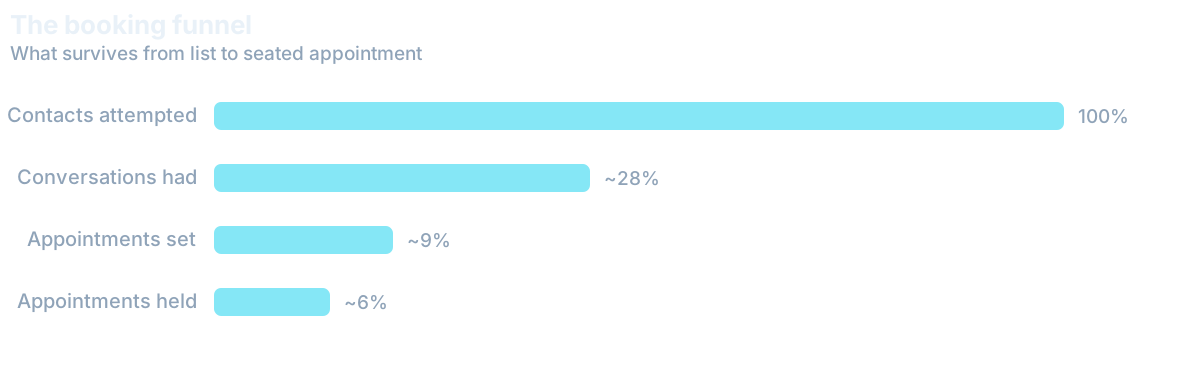
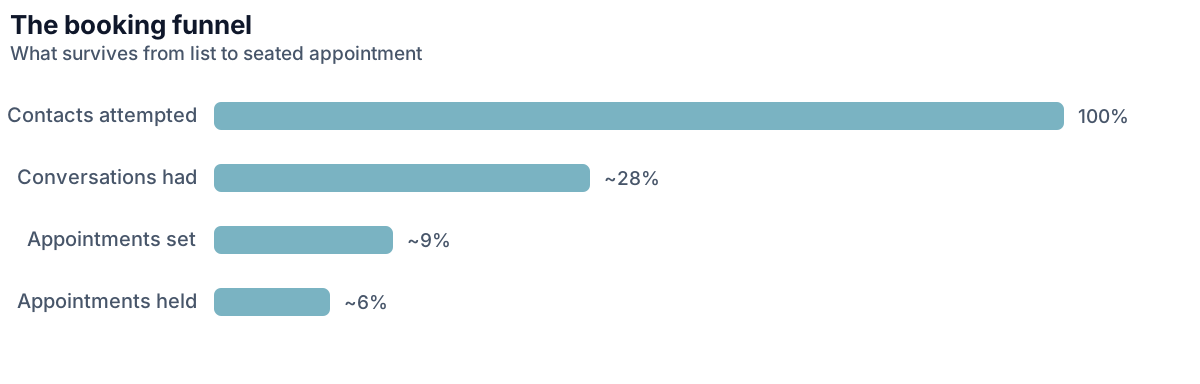
Show rate is the proportion of booked meetings that take place, and it is where most appointment-setting engagements quietly fail. Twenty bookings a week at a thirty per cent show rate is six conversations and a great deal of wasted calendar. Twelve bookings at a seventy per cent show rate is eight conversations and a calmer week.
The second is better on every dimension and looks worse on the dashboard, which is why the metric you choose determines the behaviour you get. If you reward booking volume, you will receive booking volume, and you will conclude that appointment setters do not work while your setter is hitting the target you set.
Show rate is also largely controllable, which is what makes it a fair thing to measure. Confirmation the day before, a reminder on the morning, a calendar invitation that says what the meeting is for, and the ability to reschedule proactively rather than mark a no-show all move it substantially.
Confirmations and reminders are fixed messages on a fixed schedule, so they are a good job for a Digital Employee working alongside your setter. The setter keeps the conversations and the judgement calls, such as who qualifies and who gets rescheduled, while the reminders go out on time without eating into calling hours.
None of this works without a list worth calling. A setter given a stale or badly targeted list will produce poor numbers no matter how capable they are, and the numbers will look like a performance problem. Check the list before you check the person. It is the more common explanation and the cheaper one to fix.
The Four Numbers Worth Tracking
Everything else is noise at small scale. These four tell you where a problem is, which is more useful than telling you that a problem exists.
- Contact rate - connections per attempt. Low means a list or timing problem, not an effort problem.
- Qualification rate - proportion of connections meeting your criteria. Low means the list is wrong or the criteria are too tight.
- Booking rate - qualified conversations that become meetings. Low points at the pitch or the offer.
- Show rate - booked meetings that happen. Low points at confirmation process or at qualification that was too generous.
Read them in order. A weak show rate usually traces back to qualification rather than to reminders, and a weak booking rate is more often the offer than the setter, which is worth knowing before you replace somebody who was never the constraint.
Scripts, and Where they Stop
Setters need a script and should not be held to it word for word. Its purpose is to fix the qualification questions and the opening, so that every conversation gathers the same information and you can compare across them. Beyond that, a setter reading rigidly sounds like a recording and gets treated like one.
Outcomes improve most with objection handling built from your own calls rather than from a generic template. Collect the six objections you hear on your calls, write the responses that have worked for you, and revisit them monthly with the setter. They are hearing more objections than you are, and they will know which responses stop working before you do.
Recording calls, where lawful and disclosed, is the single most useful investment in this role. It turns coaching from an argument about what was said into a shared review of what happened, and it lets a new setter learn from the calls that went well rather than from a written description of them.
Getting Qualification Right
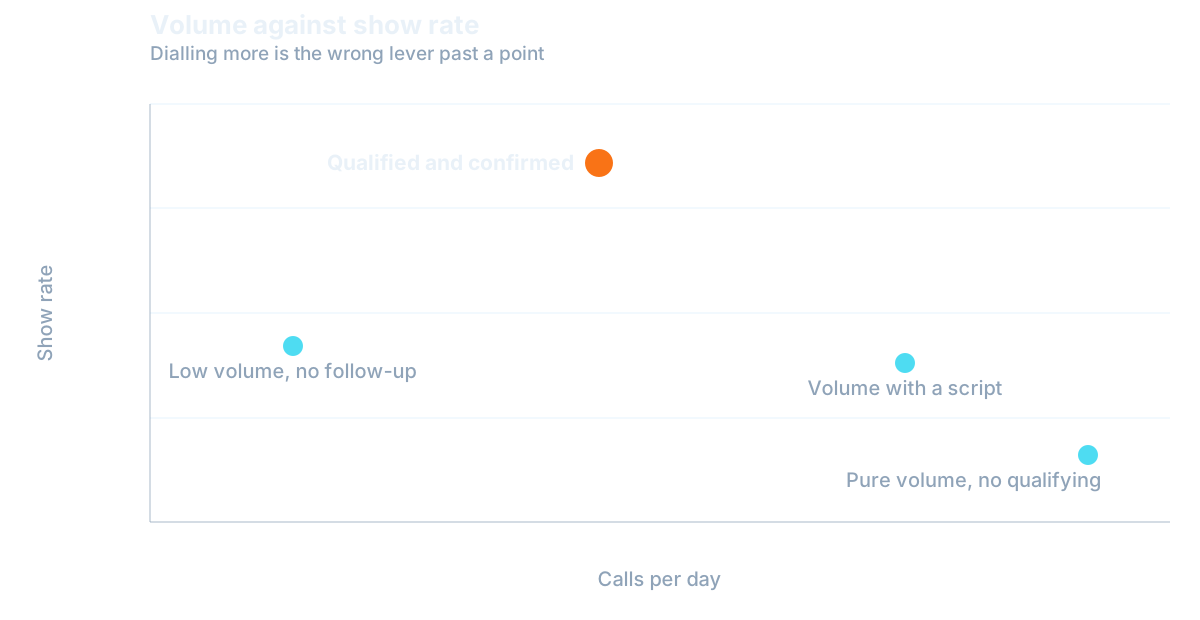
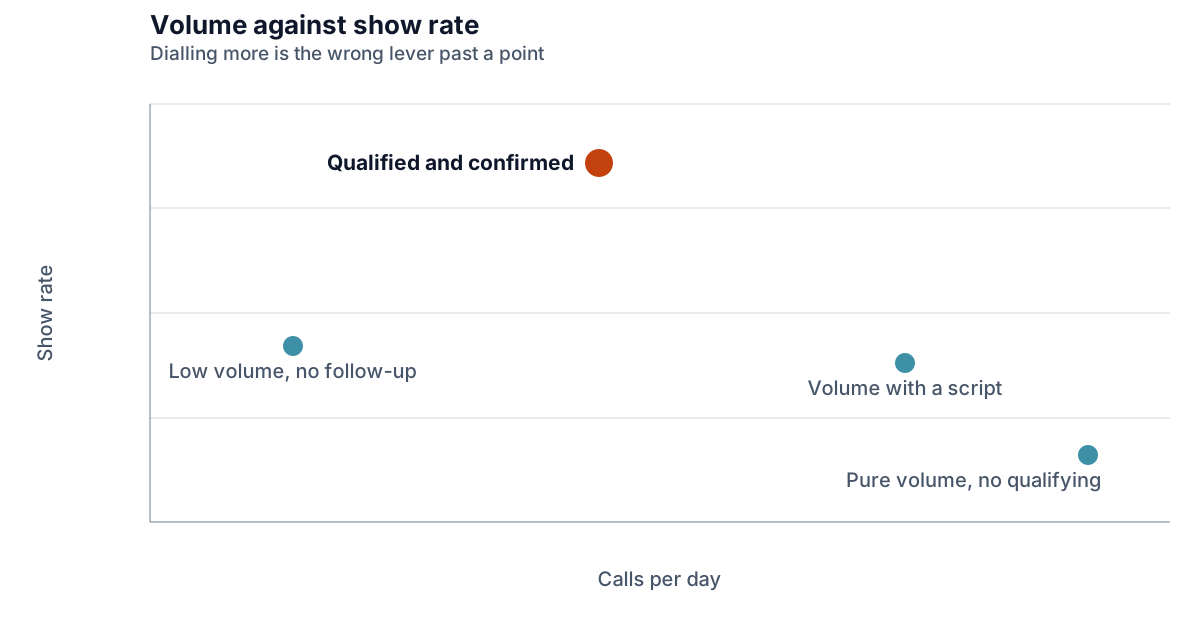
Qualification criteria that are too loose produce a full calendar of unsuitable conversations; too tight and the setter cannot find anyone. Most engagements start too loose, because the temptation early on is to prove the role is working by filling the calendar.
Write criteria as observable facts rather than judgements. 'Has bought a similar service before' is checkable; 'seems serious' is not. Give the setter permission to disqualify, and mean it: a setter who believes disqualifying will be read as underperformance will book marginal meetings, and you will spend your week discovering that in person.
Turnover in this role is high across the industry, and the reason is rarely money. Setters leave engagements where the criteria change weekly, where they are blamed for the offer, or where nobody tells them what happened to the meetings they booked. Closing that loop, letting them know which conversations converted, costs nothing and is the single most effective retention step available, which is also why how you vet and set up the role matters more than the individual hire.
How to Manage an Appointment Setter Well
This role has faster feedback than almost any other, which makes it easy to manage badly. Daily numbers make weekly panic tempting, when the useful unit is a fortnight, enough volume to distinguish signal from an ordinary bad run.
Listen to calls rather than reading summaries, at least at first. Fifteen minutes of recordings tells you more about qualification and tone than a month of statistics, and it usually reveals that the constraint is somewhere you were not looking, the list, the offer, the timing, rather than in how hard somebody is working. When the role is scoped right, see the full range of virtual assistant roles we place and support.
Want this handled for you?
We map the work eating your week and match a skilled specialist, typically in 7-14 days.