

Bookkeeping Virtual Assistants: What They Do and What You Must Keep

What does a Bookkeeping Virtual Assistant do?
A bookkeeping virtual assistant keeps your financial records current and accurate. That means categorising transactions, reconciling accounts against statements, raising and sending invoices, chasing payment, recording bills, matching receipts, maintaining supplier and customer records, and producing the routine reports you or your accountant need at month end.
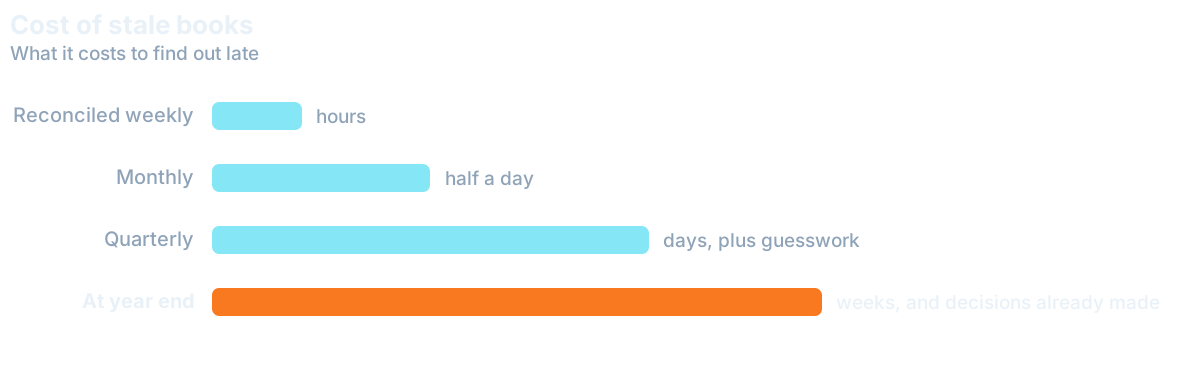
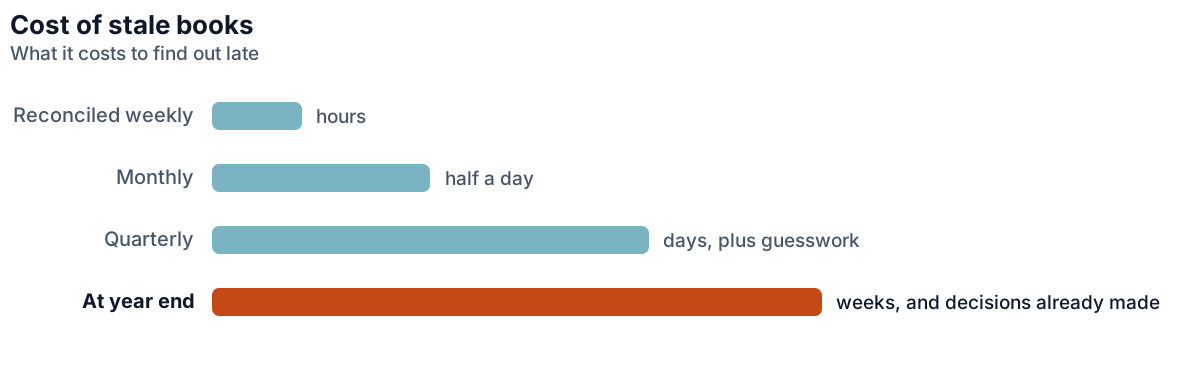
What they are doing, underneath all of it, is making sure your numbers are true on any given day rather than reconstructed in a panic each quarter. For most small businesses the problem is currency: the data exists but is three months stale, which makes every decision that depends on it a guess.
That staleness compounds quietly. Cash-flow decisions get made on feel, a supplier overcharge goes unnoticed for two quarters, and the year-end costs more because your accountant is doing reconstruction rather than advice.
The Reports you will Use
The reporting side is worth being specific about, because 'produce reports' covers a wide range. A profit and loss statement, an aged debtor list showing who owes what and for how long, and a simple cash position are the three that most owners use week to week. Anything beyond those is usually produced because it can be rather than because somebody reads it.
Bookkeeping vs Accounting: Where the Line Sits
These get conflated constantly, and the distinction is practical rather than academic. Bookkeeping is recording what happened, accurately and promptly. Accounting is interpreting it: tax strategy, statutory filings, structural advice, the judgement calls that carry professional liability and require a qualification.
A bookkeeping virtual assistant should never be your tax adviser, sign a filing, or decide how something is treated for tax purposes. What they should do is deliver clean, current books to whoever does. Those two functions work best together: accountants bill considerably less when the records arriving on their desk are already accurate, and give better advice because they are looking at reality rather than an approximation.
There is a knock-on benefit owners rarely anticipate. Once the books are current, questions that used to require a project, such as which clients are profitable, what a slow month costs, or whether a price rise is overdue, become answerable in an afternoon.
The Controls that Make Virtual Bookkeeping Services Safe
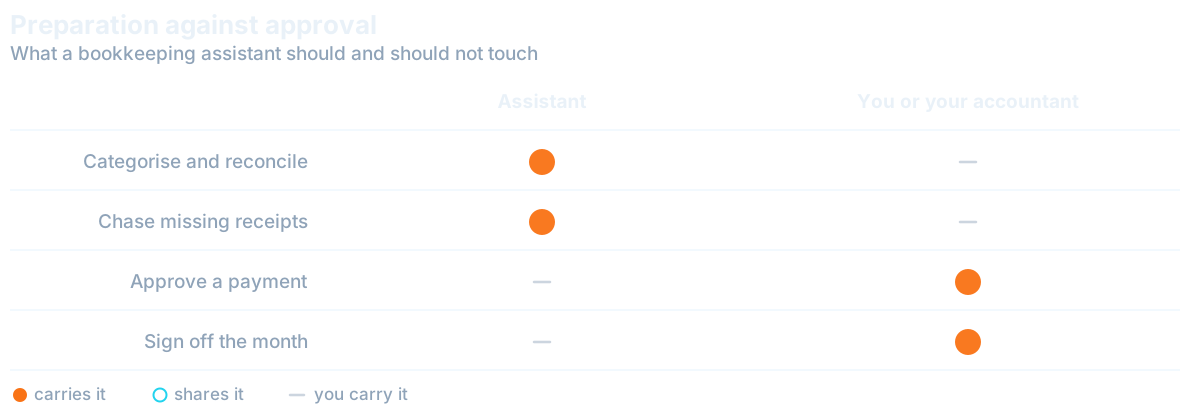
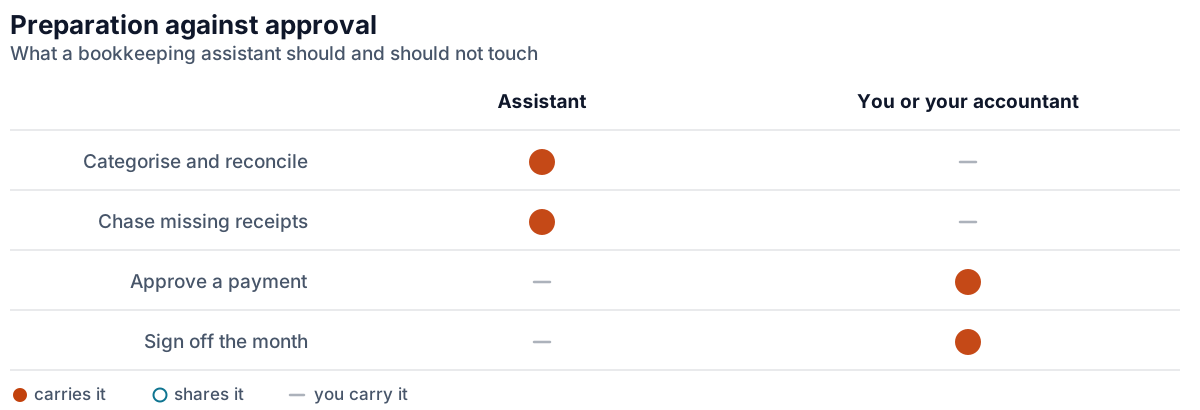
This is the role where boundaries matter most, and the good news is that the standard control is simple and well established: separate preparation from approval. The assistant prepares, you approve, and no single person can both create and authorise a payment. The same discipline as giving an assistant access safely applies here in its strictest form.
In practice that means an assistant can raise invoices, enter bills, categorise transactions, reconcile accounts and assemble a payment run. It means they should not be able to move money, change payment details on a supplier record, or approve spend above a stated limit. Most accounting platforms support this split with built-in roles, and bank access should be read-only unless there is a specific reason otherwise.
None of this reflects on a particular person. Segregation of duties is the standard control in every finance function of every size, it protects the assistant from suspicion as much as it protects you from loss, and any competent bookkeeper will expect it.
Receipt and document capture belongs here too, and it is the most reliably neglected part of the job when owners do it themselves. Photographing receipts is trivial and nobody does it consistently, which is why year-end involves reconstructing expenses from memory and card statements. Handing that to somebody who processes it daily removes a small, recurring, entirely avoidable loss.
Receipt matching and transaction categorising are also where a Digital Employee can sit beside your bookkeeping assistant. It handles the rule-based matching inside your accounting platform, the assistant reviews the exceptions, and the split between preparation and approval stays exactly where it was: nothing moves money without you. Running the two together is a Hybrid Team, and it suits books where the volume is high and the rules rarely change.
Who does What: Assistant, Owner and Accountant
The table below is worth writing into the engagement in some form, because ambiguity here is expensive in a way that ambiguity about calendar management is not.
| Task | Assistant | You | Accountant |
|---|---|---|---|
| Categorise transactions | Prepares | Spot-checks | Reviews at year end |
| Reconcile accounts | Prepares | - | Confirms |
| Raise and chase invoices | Owns | Escalations only | - |
| Pay suppliers | Prepares the run | Approves and releases | - |
| Change supplier bank details | Never | Verifies and changes | - |
| Tax treatment decisions | Never | - | Decides |
| Statutory filings | Never | Signs | Prepares and files |
The supplier bank details row deserves emphasis, because invoice fraud almost always arrives as a plausible request to update payment details. Make that change something only you do, after verifying by a channel other than the one the request arrived on.
Platforms: QuickBooks, Xero and What Fluency is Worth
Most bookkeeping assistants work in QuickBooks, Xero or an equivalent, and fluency in yours shortens onboarding here more than in other roles, because the workflows are platform-specific rather than generic. Ask about it, but weigh accuracy and diligence higher: the person who reconciles carefully in an unfamiliar system is worth more than the fast one who does not.
- QuickBooks Online
- Xero
- FreshBooks
- Wave
- Bill.com
- Dext
- Hubdoc
Cash collection is worth calling out separately, because it is the part most owners hate and therefore do least consistently. Invoices chased on a schedule by somebody who is not emotionally involved get paid materially faster than invoices chased by an owner who feels awkward about it, and the awkwardness is why the task keeps slipping.
When it is Time to Hire a Bookkeeping Assistant
The signals here are unusually concrete, which makes this an easy hire to time correctly. If you cannot say what you are owed without opening a spreadsheet, if reconciliation happens quarterly rather than monthly, if invoices go out late because raising them is nobody's job, or if your accountant's year-end fee includes a large tidying component, the role pays for itself directly. It also helps to know what a virtual assistant costs before you compare it against that year-end bill.
There is also a threshold most owners cross without noticing. Once transaction volume passes the point where you can hold the month in your head, doing it yourself stops being thrift and becomes risk: catching an error requires the kind of systematic attention that a busy owner cannot reliably give a task they resent. When the timing is right, browse the full set of virtual assistant roles we recruit and manage.
Want this handled for you?
We map the work eating your week and match a skilled specialist, typically in 7-14 days.