

Online Business Manager or Virtual Assistant: Who Should You Hire?

Online Business Manager vs Virtual Assistant: What is the Difference?
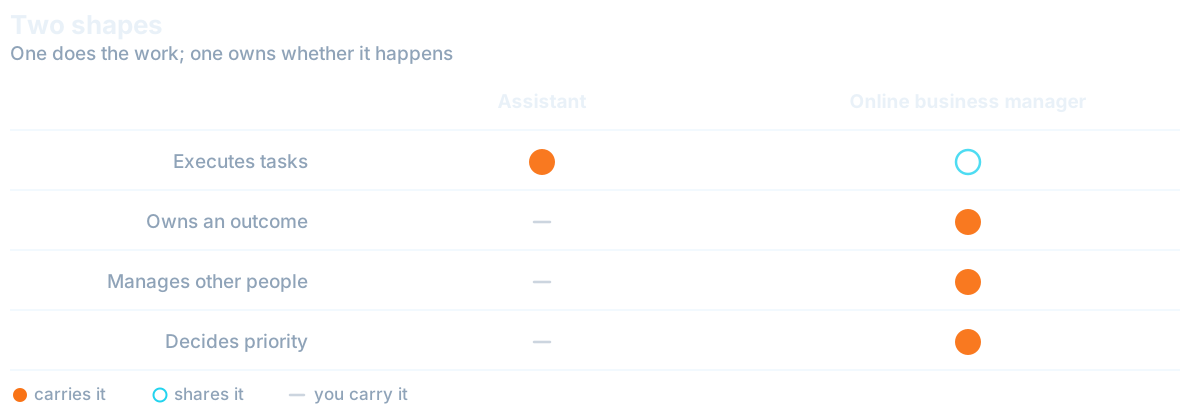
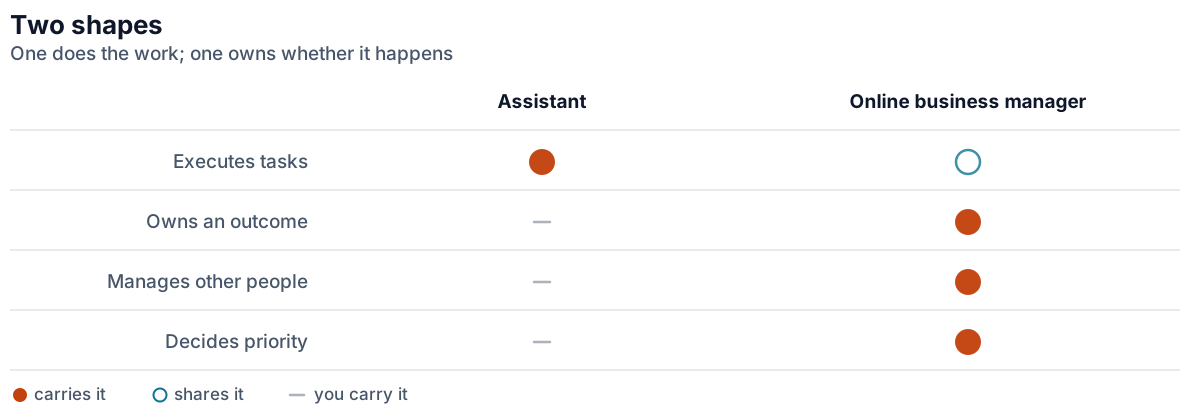
The distinction is straightforward and consistently blurred in job adverts. A virtual assistant executes tasks. An online business manager owns outcomes and directs whoever executes them, including other assistants. One is capacity, the other is a layer of management, and they solve entirely different problems.
If your problem is that there is more work than hours, you need capacity. If your problem is that you are personally coordinating three people and answering questions all day, you need management. Owners regularly buy the second when they need the first, because the second sounds more strategic, and end up paying manager rates for somebody with nobody to manage.
The title is loosely used. Some people advertising as online business managers are experienced operators who run teams; others are assistants who have adopted a more marketable label. The distinction shows up quickly in an interview if you ask what outcomes they owned and who reported to them, rather than what tasks they performed.
What does an Online Business Manager Own?
An OBM takes responsibility for projects reaching completion, for the team's work being coordinated, and for the operational systems holding together. Concretely: running the delivery calendar, assigning and tracking work across assistants and contractors, owning process documentation, onboarding new team members, reporting on what is on track and what is not, and being the person your team asks instead of you. In that respect the role sits closer to a virtual project manager than to a task-doing assistant.
The distinguishing feature is that an OBM is measured on outcomes rather than tasks. 'The launch shipped on the fifteenth' is an OBM's result. 'Twelve emails scheduled' is an assistant's. If everything you want from the role can be written as a task list, you have described an assistant with an expensive title.
The clearest signal that you need this role is that your assistants have started asking each other questions and getting different answers. That is coordination failing, and it improves when somebody is made responsible for the answer being consistent.
The Expensive Mistake: Hiring an OBM Too Early
Hiring an OBM too early is the most common failure with this role, and it happens for an understandable reason: the owner is overwhelmed, and management sounds like the answer to being overwhelmed. But a manager with no team to manage becomes an expensive assistant, and both sides feel the mismatch within a month.
There is a second version that hurts more. An OBM hired to fix undefined processes will spend their first months writing documentation you could have had an assistant write, at roughly twice the rate, while the work itself continues to sit on your desk. Management is a multiplier on execution capacity, and multiplying by very little produces very little. This is a question of what to delegate first, and in what order.
There is a diagnostic worth running before you decide. For one week, log every interruption that came from your own team rather than from a client, and mark whether it was a question you alone could answer or one that somebody else in the business could have. If most fall into the second category, you have a coordination problem and a manager solves it. If most required you, adding a layer will not help.
A Threshold you can Check
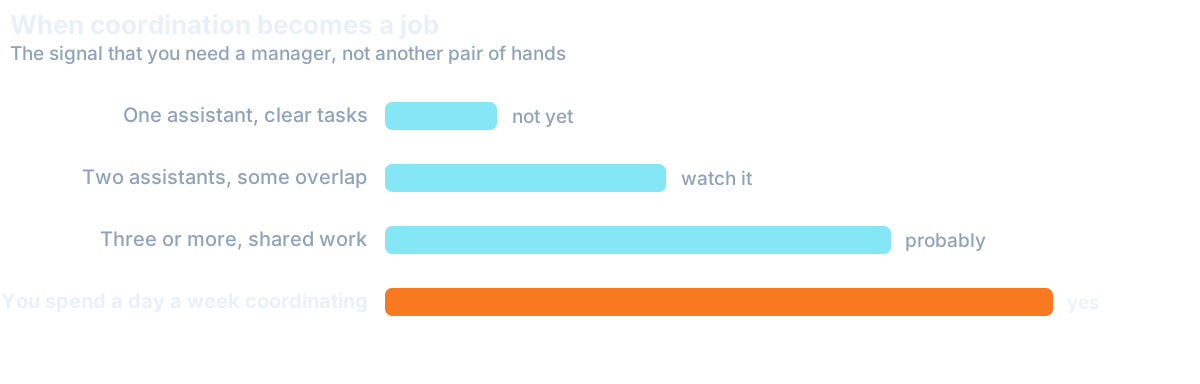
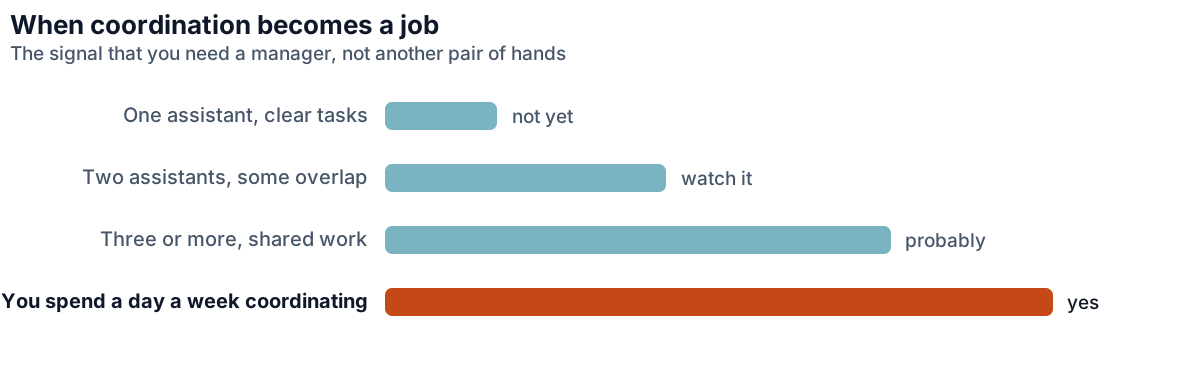
The practical test is a count rather than a feeling. If you are directing three or more people whose work interacts, and you are spending real time each week on coordination, deciding sequencing, answering questions, chasing status, resolving overlaps, that coordination is a job, and it is currently yours.
Below that, almost certainly not yet. Two assistants working on separate things need occasional direction rather than management, and adding a coordination layer creates a longer path between you and the work for no benefit. The signal is whether the interactions between people have become the thing consuming you, more than headcount alone.
One practical note on cost. An OBM commands meaningfully more than an assistant, and the arithmetic only works if that rate buys back a block of your own time large enough to matter. If coordination is consuming two hours a week, the multiplier is too small. If it is consuming a day, the case makes itself.
Online Business Manager vs Virtual Assistant, Side by Side
| Virtual assistant | Online business manager | |
|---|---|---|
| Solves | Not enough hours | Too much coordination |
| Measured on | Tasks completed well | Outcomes delivered |
| Direction | Receives it | Provides it |
| You supply | Process and priorities | Goals and constraints |
| Right when | Work exceeds your hours | Coordinating others exceeds your hours |
| Fails when | The process was never written | There is nobody to coordinate |
The Hiring Sequence that Usually Works
Start with an assistant and let the work define the shape. As the first one becomes fully occupied, add a second for a distinct function rather than splitting the first person's job. Keep directing them yourself, and pay attention to how much of your week that direction consumes.
When coordination has become a recognisable block in your calendar, you notice it, you resent it, you can name the hours, that is the moment an OBM converts from a cost into leverage. Arriving at that point with two or three assistants already running gives the manager something real to manage on day one, along with documented process and a team that already knows how things work.
The reverse order can succeed, but it requires the OBM to build the team and the process from nothing while you continue absorbing the operational load. That is a slower and more expensive route to the same place, and it is usually chosen because the title sounded like the solution to a feeling rather than to a specific, countable problem. If capacity is the real gap, start with the right virtual assistant role and add the management layer only when the coordination is undeniable.
Want this handled for you?
We map the work eating your week and match a skilled specialist, typically in 7-14 days.