

Executive Assistant or Administrative Assistant: Which Do You Need?

Virtual Executive Assistant vs Virtual Administrative Assistant: What is the Difference?
The two titles are used interchangeably in job adverts and mean different things in practice, which is why so many placements disappoint. The distinction is the direction the work flows, not seniority or pay: a virtual administrative assistant responds to work that arrives, and a virtual executive assistant anticipates work before it does.
That sounds like a small distinction, and it changes everything about who you should hire. Reactive work rewards accuracy, speed and consistency, so you want somebody who processes a queue reliably and never drops anything. Anticipatory work rewards judgement and context, so you want somebody who notices that a client has not been contacted in six weeks and raises it without being asked.
Very few people are outstanding at both, and asking one person to do both usually means the anticipatory half quietly disappears, because the reactive queue always feels more urgent. Deciding which you need is a question of what to delegate first, not which title sounds more impressive.
What does a Virtual Administrative Assistant do?
A virtual administrative assistant owns throughput: data entry and CRM hygiene, document preparation from templates, invoice and expense processing, scheduling within defined rules, file organisation, standard correspondence, and order and supplier processing. The work arrives, it gets handled correctly, and it does not come back.
The value here is easy to underestimate because each task is small. What it buys is the removal of a whole category of interruption from your week, plus the confidence that things are not silently rotting in a queue. For most owners this is the right first hire, because the work is defined enough to transfer cleanly and the results are visible within days rather than months.
Why Administrative Support is Usually the Faster First Hire?
It is also the role most owners already know how to brief, because the outputs are concrete. You can describe a correctly prepared invoice or a clean CRM record; describing 'manage my priorities' is considerably harder, which is one practical reason the administrative version transfers so much faster.
What does a Virtual Executive Assistant do?
A virtual executive assistant owns your attention. That means gatekeeping, deciding what reaches you and what gets handled or deferred, plus calendar strategy rather than calendar entry, meeting preparation with the relevant context assembled beforehand, relationship maintenance, and following up on the things you said you would do and have not.
The distinguishing capability is judgement under ambiguity. An executive assistant who asks what to do with every unusual request is not doing the job; the job is to resolve most of them and escalate the real exceptions. That requires enough context about your business, your priorities and your relationships that it cannot be handed over in a first week, which is why executive assistant placements take longer to become valuable and are more damaging to get wrong.
The pay follows from the skill rather than from status. Anticipatory work commands more because the pool of people who do it well is smaller, and because the cost of getting it wrong is higher. Budgeting for an executive assistant rate and then writing an administrative brief is a common way to overpay for work you could have specified more cheaply.
Executive Assistant vs Administrative Assistant, Side by Side
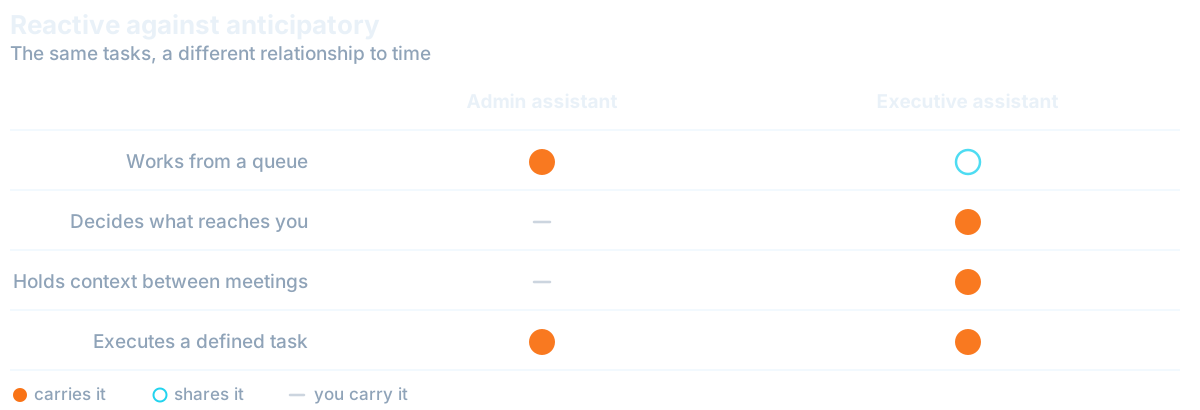
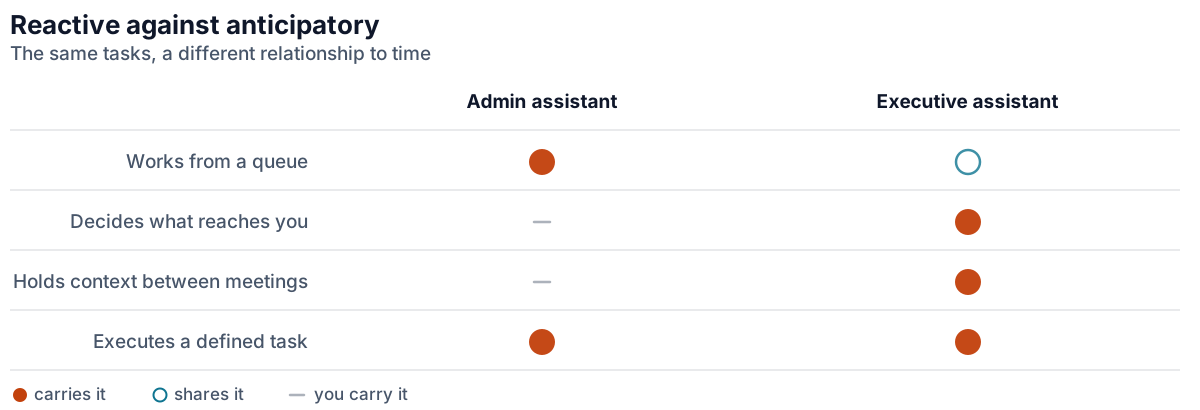
The table compares them on what determines fit. Read the last two rows first, because they predict satisfaction better than any skills list: they describe what you have to supply rather than what you receive.
| Administrative assistant | Executive assistant | |
|---|---|---|
| Work direction | Reactive, handles what arrives | Anticipatory, surfaces what has not yet |
| Core skill | Accuracy and consistency | Judgement and context |
| Owns | Throughput and records | Your attention and follow-through |
| Decides | Within written rules | What reaches you at all |
| Time to value | Days | Months |
| You must supply | Defined processes | Context, priorities and trust |
| Fails when | The process was never written | They are treated as a task queue |
One consequence worth planning for: an executive assistant needs access to context that an administrative assistant does not. They will see your calendar in full, read correspondence you have not filtered, and know which relationships are strained. It means the trust question is real rather than ceremonial, and it should shape how you vet and hire rather than being discovered afterwards.
Why the Wrong Hire Fails, and How to Spot it Early?
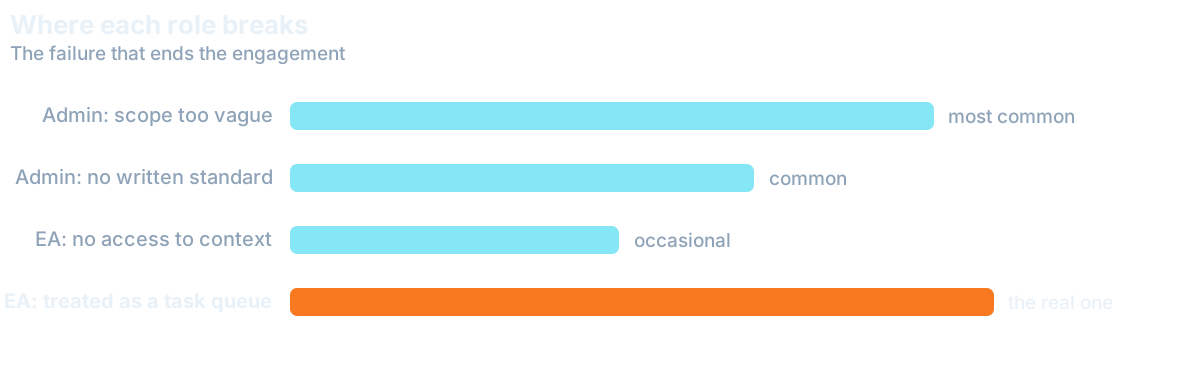
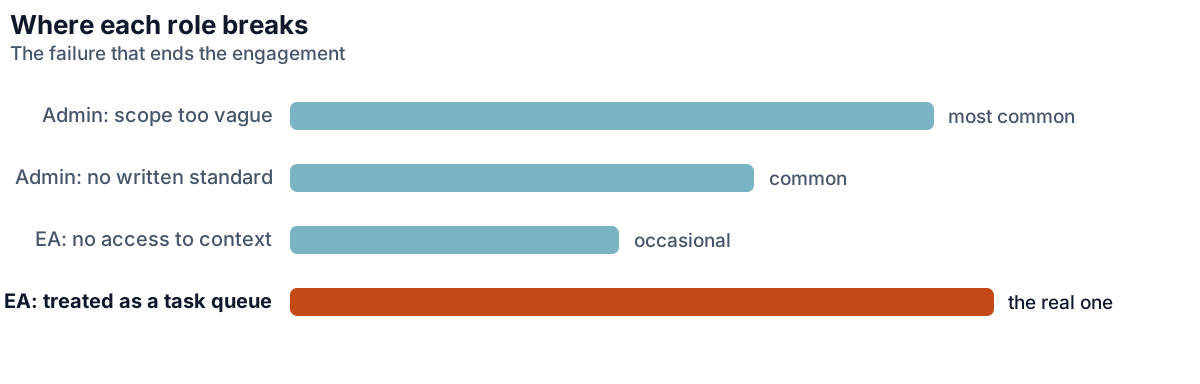
The most common failure is hiring an executive assistant and then using them as an administrative one. It happens gradually and with good intentions: the queue is visible and urgent, the anticipatory work is neither, so week by week the executive assistant is absorbed into processing. Six months later they leave, and the diagnosis is a personality mismatch when it was a role definition problem.
The reverse failure is quieter and just as expensive. An administrative assistant given executive expectations, 'anticipate my needs, manage my priorities, know what matters', will produce reasonable work and constant low-grade disappointment, because the brief was never something they agreed to or were hired against. Neither of these is the assistant's fault, and both are visible in the job description if you read it closely before hiring.
How to Choose the Right Assistant the First Time?
Write down the ten things you most want off your plate, then mark each one as either 'arrives and needs handling' or 'needs somebody to notice it'. If the list is overwhelmingly the first kind, hire an administrative assistant and be pleased with how fast it works. If it is mostly the second kind, you need an executive assistant and should plan for a longer ramp.
If the list is mixed, which it usually is, start administrative. The reactive work is what is drowning you today, it transfers in days rather than months, and it produces the documented process and the working relationship that an anticipatory role depends on anyway. Many strong executive assistants began as the administrative hire and grew into the wider brief once the context was there. When you are ready, browse the full set of virtual assistant roles we recruit and manage.
Want this handled for you?
We map the work eating your week and match a skilled specialist, typically in 7-14 days.