

What a Social Media Virtual Assistant Can and Cannot Own?

Why "Own our Social Media" Almost Never Works?
It is the most common brief and the most reliable way to be disappointed. Social media is four jobs with different requirements, and handing all four to one person without saying which matters produces output that is technically present and strategically pointless: posts going out on schedule that nobody engages with, and no way to say what went wrong.
The owner concludes that social media assistants do not work. What happened is that nobody specified whether the person was being hired to decide what to say, to make the things, to put them out, or to talk to the people who respond. Those are four different skills and only two of them transfer easily.
Someone perfectly able to produce good work will still produce mediocre work against an undefined brief, because they are optimising for something they had to guess. The specification is the deliverable you owe them, which is the discipline behind deciding what to delegate first.
The Four Jobs Inside Social Media
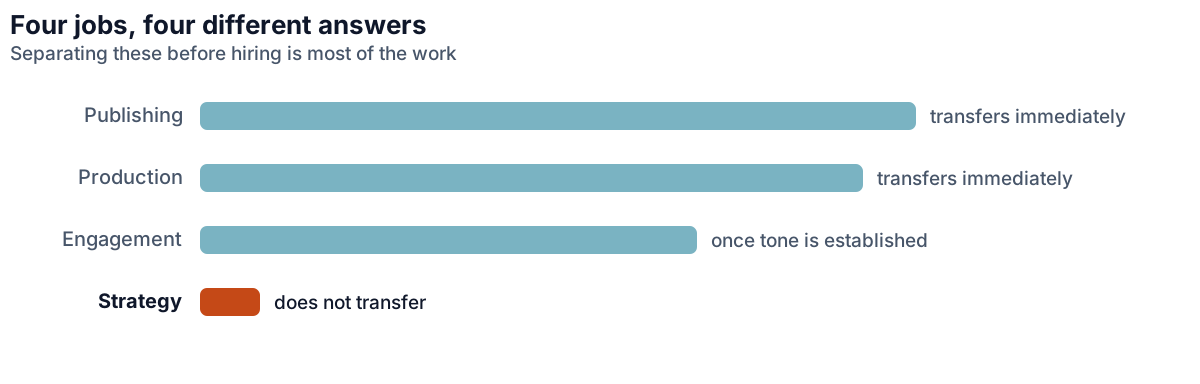
Separating these before hiring is most of the work, and it takes about twenty minutes. Strategy decides what the account is for, who it speaks to and what it says. Production makes the assets: writing, editing, graphics, video cuts. Publishing schedules and posts them consistently and correctly per platform. Engagement replies to comments and messages and behaves like a person in public on your behalf.
Strategy is the One Job that does not Transfer
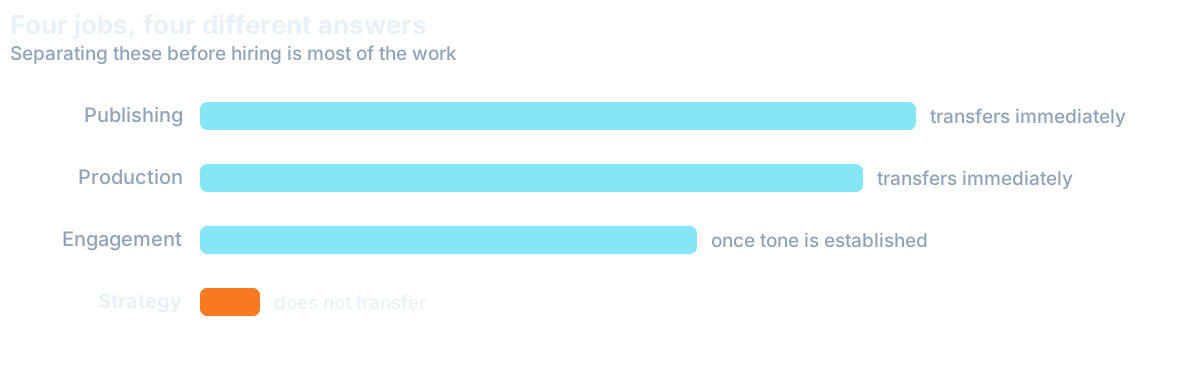
Production and publishing transfer cleanly and immediately. Engagement transfers well once tone is established. Strategy does not transfer to an assistant at all in most small businesses, because it depends on knowing where the business is going, which is your job and generally not written down anywhere they can read it.
What a Social Media Virtual Assistant Owns
Given a defined direction, a competent social media assistant runs the entire machine: turning your raw material into finished posts, maintaining a calendar so the account does not go quiet, scheduling to each platform's requirements, repurposing one piece into several formats, monitoring mentions, replying to routine comments and messages, and reporting on what happened.
Repurposing is where the value concentrates and it is consistently underused. One podcast episode, one client conversation or one long post is several weeks of material once someone is responsible for cutting it up. Most owners produce far more raw material than they publish, and the gap between the two is what this role closes.
Repurposing is also the most mechanical end of the job, which is why it pairs well with a Digital Employee. One can cut a long piece into first drafts and queue them on the calendar, while your assistant edits for tone, picks what runs and handles the replies. People and Digital Employees on the same account is a Hybrid Team, and anything that commits the business publicly still comes to you.
Consistency is the other underrated output. Most small-business accounts do not fail because the content was poor; they fail because publishing stopped for six weeks during a busy period and never properly restarted. An assistant whose job includes the calendar removes that failure mode entirely, which is worth more than any individual post.
What should Stay with you?
Strategy stays, and it needs to be written down rather than held as an instinct: what the account exists to achieve, who it is talking to, which topics are on and off limits, and what a good month looks like. An assistant without that is guessing, and their guesses will be reasonable and not yours.
Two other things stay. Anything that commits the business publicly, pricing, policy, announcements, responses to criticism that go beyond acknowledgement, because those are statements from the company rather than social media activity. And relationship-level conversations with people who matter: an assistant can spot that a significant prospect commented, but the reply should come from you.
Platform mechanics deserve a mention because they are delegable and fiddly. Aspect ratios, character limits, how each platform treats links, when native uploads outperform shared ones. This is the sort of knowledge that is tedious to maintain and easy to hand over, and getting it wrong quietly suppresses reach in ways most owners never notice.
How to Get the Brand Voice Right
Voice is the usual anxiety and it has a mechanical answer: examples, not adjectives. Hand over twenty posts you were happy with, five you were not, and a short list of words and phrases you never use. This settles the question far more reliably than describing your tone as "friendly but authoritative", which every person interprets differently, and it doubles as the start of an SOP your assistant will follow.
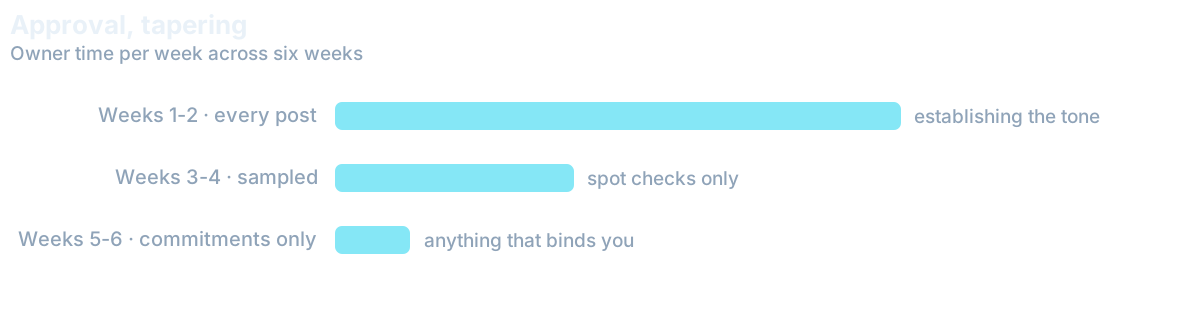
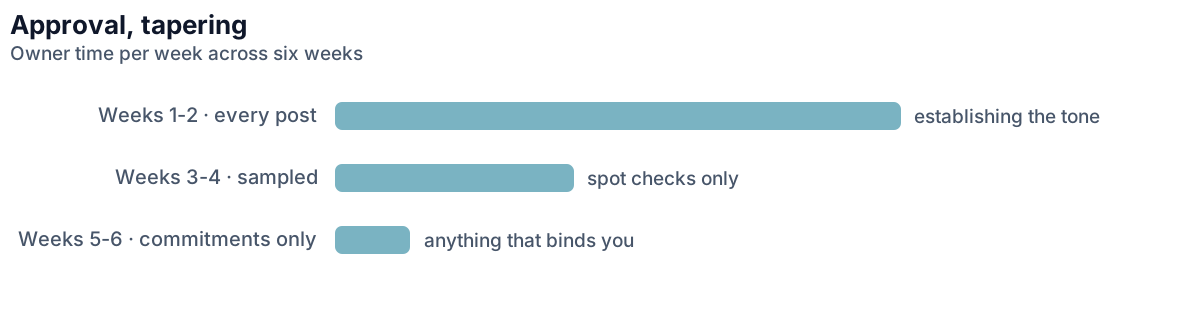
Run approval in stages rather than permanently. Everything approved for the first fortnight, then a sampled review, then approval only for anything that commits the business. Teams that keep approving every post indefinitely have added a drafting step to their own calendar and given it a new name.
How to Measure a Social Media Assistant
Judge a social assistant on what they control. Consistency of publishing, response time to comments and messages, volume of material produced from each input, and adherence to the calendar are all theirs. Follower growth and inbound leads are outcomes of strategy, market and offer, largely yours, and holding someone to them produces either anxiety or quiet gaming of the metric.
The most useful early indicator is whether the account continues to publish and reply during a week when you are unavailable and thinking about something else entirely. If it does, the transfer worked. If it goes quiet, the work is still yours and the assistant is drafting on your behalf, which is a different and much smaller thing than the one you hired for.
Want this handled for you?
We map the work eating your week and match a skilled specialist, typically in 7-14 days.