

How Companies Use Virtual Assistants to Scale Operations Fast

There is a specific kind of busy that feels like progress and is not. The calendar is full, the inbox is handled, every day ends with things crossed off, and the business is where it was ninety days ago. Almost every founder we work with arrives in that state, and almost none of them describe it as a delegation problem. They describe it as needing more hours.
What follows is how companies that scale quickly structure the work, which comes down to removing themselves from the operations that consume those hours.
What a Virtual Assistant is, and What it is not
A virtual assistant is a remote professional who takes ownership of defined operational work: inbox and calendar, customer follow-up, CRM accuracy, reporting, research. The word 'assistant' undersells it and causes most of the disappointment. Treated as an errand service, you get errands. Treated as an operator who owns a slice of the business, you get capacity.
The practical difference is measurement. An errand runner is judged on responsiveness; an operator is judged on whether their part of the machine keeps running without you looking at it. That second arrangement is the one that changes anything.
Why Delegation is the Constraint on Growth?
Every founder has a small number of hours that only they can spend usefully: selling, building relationships, making judgement calls that require context nobody else has. Those hours are the growth engine. Everything else is maintenance, and maintenance expands to fill whatever time you leave available for it.
Companies that scale fast are not working more hours than you. They have arranged things so their scarce hours are spent almost entirely on the growth engine, and the maintenance is owned by someone else. That is the whole mechanism behind the much-discussed virtual assistant team outsourcing benefits, and it is far less sophisticated than it sounds, which is also why it is so easy to postpone.
The Cost Comparison People Get Wrong
Most cost comparisons put a salary next to a monthly fee and stop there, which is why the conclusion is usually wrong. An employee carries payroll taxes, benefits, equipment, software seats, physical space, and the management overhead of someone who needs supervision, plus a ramp period during which you are paying full cost for partial output.
The part that gets missed entirely is that fixed headcount does not flex. It continues at the same rate through slow quarters, when it hurts most. A managed engagement converts most of that into a predictable, adjustable line, and the ramp is shorter because the person arrives already skilled. We break the full arithmetic down in virtual assistant vs a full-time employee.
Where the Time Goes
Daily operations are where growth quietly dies. Any single task is cheap; the switching between them is what costs. A founder who checks email between client calls is not spending fifteen minutes on email; they are spending fifteen minutes plus the time it takes to get their head back into the work that mattered.

The companies that get this right hand over whole categories of work with a standard attached. 'Own the inbox' is a category. 'Forward me anything urgent' is not, because it leaves the judgement, and therefore the interruption, with you.
What Gets Handed over First?
The best first candidates share three traits: they happen often, they follow a repeatable pattern, and they require little of your specific judgement. That combination is what makes the training investment pay back quickly, and it is why inbox and CRM work almost always tops the list. Most of these map neatly onto the specialist virtual assistant roles teams start with.
- Inbox triage and calendar coordination
- CRM updates, data entry and pipeline hygiene
- Customer follow-up and first-line support
- Reporting, research and list building
- Social posting and content scheduling
Notice what is absent: pricing decisions, relationship calls, anything requiring context that lives only in your head. Those come later, if at all, and trying to delegate them in month one is the fastest route to concluding that delegation does not work.
How to Start without it Falling Apart
Most failed delegation attempts skip straight to handing over work. The sequence below is deliberately slower at the start, because the time spent defining the work is recovered several times over in not having to re-explain it.
- Track your own week honestly, noting what consumed time and whether it needed you specifically
- Split that list into growth work and maintenance work
- Choose one maintenance category, not five tasks from five categories
- Write down what 'done' looks like, and record yourself doing it once
- Hand it over with a daily review for the first fortnight, then move to weekly
Once one category runs without you, the second is dramatically easier, because you now have a working template for the handover itself.
That written template also shows whether the next category needs a person at all. Where the process is the same steps every time, a Digital Employee can run it; where it needs calls, relationships or judgement, a VA does, and plenty of categories need both. Our guide to the ways to hire lays out how a virtual assistant, a Digital Employee and a Hybrid Team differ, so each category goes to the right one.
Why this Matters More for Small Teams?
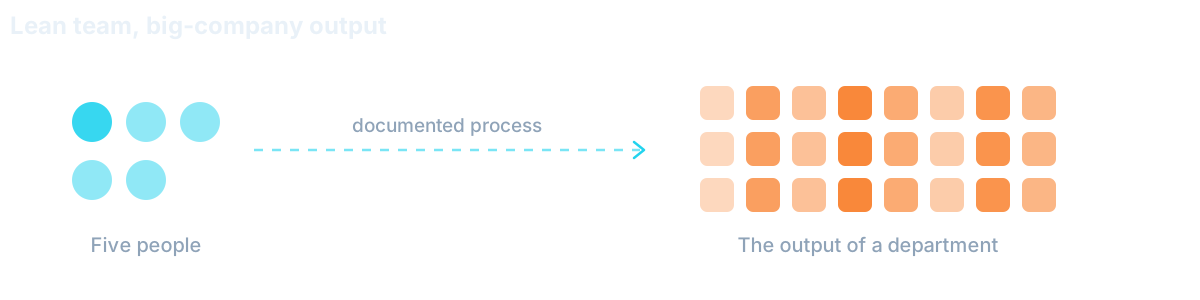
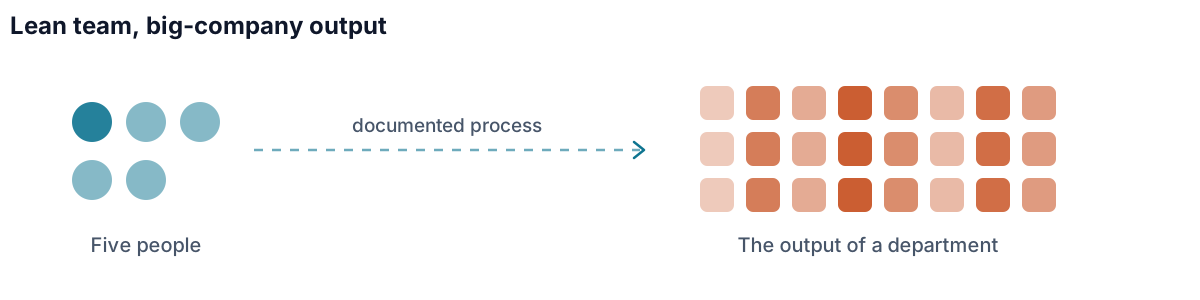
A large company absorbs operational drag because it has depth. A small team does not: when the founder is the bottleneck, everything downstream waits. That is why lean operations often out-execute better-funded competitors: they have removed the person-shaped constraint from the middle of the workflow rather than hiring around it.
It also changes what growth costs. Adding capacity through a managed engagement is reversible and quick; adding it through headcount is neither, and the difference matters most in the moments when you are least certain about demand.
The Mistakes that Make it Fail
These are consistent across almost every stalled placement we see, and none of them are about the assistant's ability.
- Delegating tasks but keeping the decisions, so every item still routes through you
- No written standard, which makes feedback feel arbitrary
- Expecting month-three output in week one
- Hiring on hourly rate rather than on the skill the role needs
- Never revisiting the scope once it works, so the arrangement stops compounding
What Changes?
The immediate return is hours, and that is what everyone notices first. The more valuable return is that the business stops depending on your attention to function, which is the precondition for it being worth anything without you in it.
If you are unsure which tasks to hand over first, that is the normal starting position and it is worth resolving before hiring anyone. When you are ready to structure the handover itself, our ten-day onboarding plan covers the sequence in detail, and you can see how we staff virtual assistants by industry.
Want this handled for you?
We map the work eating your week and match a skilled specialist, typically in 7-14 days.