

How to Onboard a Real-Estate Virtual Assistant in 10 Days

Most agents who tell us "the VA did not work out" describe the same fortnight. The assistant started on a Monday, spent three days waiting on logins, got handed tasks by voice note, and by week three was guessing. Nobody was lazy. There was no system for the handover, and a capable person was quietly set up to fail.
Onboarding is the part of hiring that determines the outcome, and it is the part almost everyone improvises. What follows is a ten-day structure that removes the guesswork by forcing the preparation into the open before anyone is paying for idle time.
What does a Real-Estate Virtual Assistant do?
A real-estate virtual assistant is a remote professional who runs the operational half of the business: the follow-up, the CRM hygiene, the paperwork chasing, the appointment logistics. A well-scoped assistant owns a defined slice of the pipeline and is measured on it, which is what separates a hire that compounds from one that just absorbs your time in supervision.
In practice the work clusters into three shapes: generating and chasing leads, keeping the CRM truthful, and moving files toward closing. Most agents need one of those badly and the other two eventually. Deciding which one you are hiring for is the single highest-leverage thing you do before day one.
Why Onboarding Decides Whether the Hire Works?
The failure mode is rarely dramatic. Tasks get done inconsistently, small mistakes accumulate, and the agent starts checking everything: which costs more time than doing the work themselves. Six weeks later the conclusion is "virtual assistants do not work for my business," when the real cause is that the assistant was never given a definition of finished.
Preparation is what prevents that, and it is unglamorous: written expectations, system access, and a small number of tasks with a clear standard. Skip it and the first week goes to account requests instead of training, which means the assistant is three days behind before they have done anything measurable.
What to have Ready before Day One
None of this needs to be polished, and perfectionism here is its own delay. A rough written outline plus a screen recording beats a beautifully formatted manual that never gets finished. Have the assistant convert your recordings into written SOPs during their first week. The documentation then gets built as a by-product of training rather than as a project you keep postponing.
- A written list of the tasks this person owns, and what "done" looks like for each
- Logins to the CRM, email, calendar and dialer, created and tested in advance
- Scripts or templates for anything involving client contact
- One communication channel, agreed: not four
- A named person who answers their questions in week one
Define the Role before you Define the Tasks
Most assistants underperform because the role was never bounded. "Help me with admin" is not a role; it is a hope. The clearer version names the slice of the business the assistant owns, which lets you judge performance on outcomes instead of activity.

Three shapes cover the majority of real-estate placements, and it is worth picking one deliberately rather than blending all three in month one. A blended role is the most common cause of an assistant who looks busy and moves nothing.
- Lead generation - outbound calling, follow-up sequences and appointment setting; measured on conversations and booked appointments
- CRM and pipeline - contact hygiene, stage accuracy, follow-up scheduling; measured on data integrity and nothing slipping
- Transaction and admin - documents, deadlines, scheduling and inbox triage, the province of an administrative assistant; measured on files moving without chasing
You can expand the role later. Starting narrow is what makes expansion possible, because it gives you a working baseline to expand from.
The Ten-Day Plan
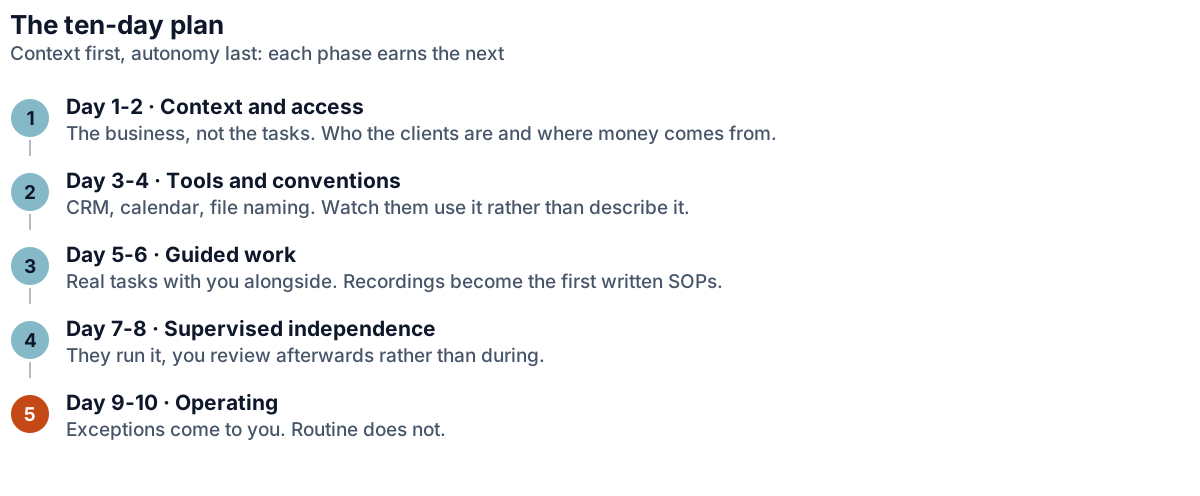
The sequence below front-loads context and back-loads autonomy. The instinct to hand over real work on day one is understandable when you are drowning, but it reliably produces an assistant who is fast and wrong. Each phase earns the next.
Day 1-2 · Context and accessSpend the first two days on the business, not the tasks. Explain who your clients are, what a good lead looks like, how you like to communicate, and where the money comes from. An assistant who understands why the work matters makes better decisions in the gaps between instructions, and there are always gaps. Confirm every login works while you are both present; discovering a broken account on day four costs a day.
Day 3-4 · Tools, especially the CRMThe CRM is where most of the value sits, so it gets disproportionate attention. Walk through how records are structured, what each pipeline stage means in your practice, and what a correctly updated contact looks like. Precision here pays for itself repeatedly, because a CRM that everyone trusts is the difference between follow-up that happens and follow-up that is theoretical.
Day 5-6 · Task training with real examplesNow train on actual work, using real records rather than hypotheticals. Demonstrate the task, then have them do it while you watch, then have them do it alone and review. Correct early and specifically, the mistakes you tolerate in week one become the standard by week four.
Day 7-8 · Supervised deliveryHand over live tasks with a daily review. The review is short, and its purpose is calibration rather than inspection. This is also where you discover which instructions were clearer in your head than on the page, which is normal and worth fixing immediately.
Day 9-10 · Independence with a scoreboardMove to defined daily responsibilities with agreed numbers attached, calls made, contacts updated, files progressed. The scoreboard matters more than the supervision from here on, because it lets you step back without losing visibility.
By day ten a properly onboarded assistant runs their slice without hand-holding, and the time you were spending on it comes back to you.
Tools they should Already Know
An assistant who has to be taught your entire stack is an assistant you are training rather than delegating to. Your brokerage usually dictates the transaction platform, so confirm compliance requirements before you decide what fluency is non-negotiable.
- Follow Up Boss
- kvCORE
- Dotloop
- SkySlope
- DocuSign
- Google Workspace
- Slack
Where Onboarding Usually Goes Wrong
The mistakes are consistent enough to be predictable, and every one of them is cheaper to avoid than to correct. The most expensive is hiring on price: a cheaper assistant who needs twice the supervision costs more than a skilled one, because your hours are the scarce resource in the equation.

- Handing over tasks without a written definition of done
- Giving everything at once instead of sequencing the handover
- Expecting week-four output in week one
- Leaving communication to whichever channel is nearest
- Choosing on hourly rate rather than on what the role requires
What Changes Once it Works?
The immediate return is time, but the durable return is consistency. Follow-up stops depending on whether you had a good week. Records stay accurate enough to act on. Clients get answers at the same speed whether or not you were showing property that afternoon, and that reliability is what turns a solo operation into something that can carry more volume without breaking.
That is also the point at which a second hire becomes obvious rather than risky, because you now have a documented process to hand to them.
Why Pre-Trained Assistants Clear the Bar Faster?
Everything above assumes you have the time to train. Most agents do not, which is why so many DIY placements stall. The plan is sound and nobody gets to week two of it.
Working with assistants who are screened and already skilled in real-estate work before they reach you removes the heaviest part of the curve. At HireTrainVA the assistant arrives already fluent in the tooling and the vocabulary, a dedicated account manager oversees the work, and every match carries a two-week replacement guarantee, so a poor fit is our problem to solve rather than your hiring cycle to repeat.
If you are weighing coordination support alongside general admin, our guide to virtual transaction coordinators covers where that role differs, and you can see how we staff virtual assistants for real-estate teams.
Want this handled for you?
We map the work eating your week and match a skilled specialist, typically in 7-14 days.