

Virtual Assistant vs In-House Employee: The Real Cost Comparison

Virtual Assistant vs In-House Employee: Why Salary is the Wrong Number
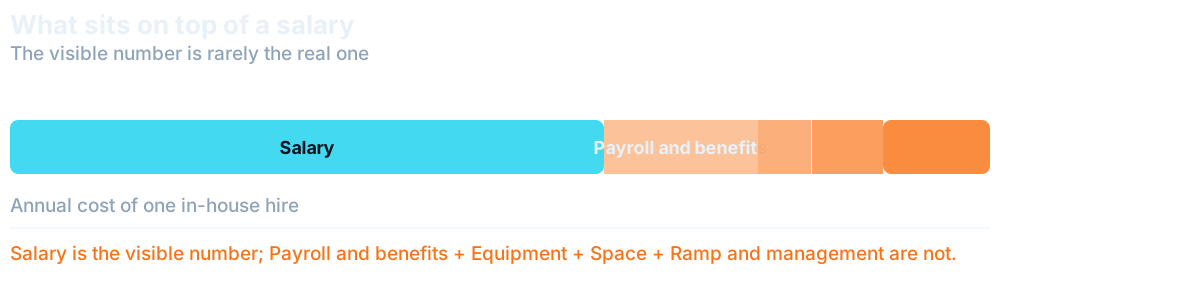
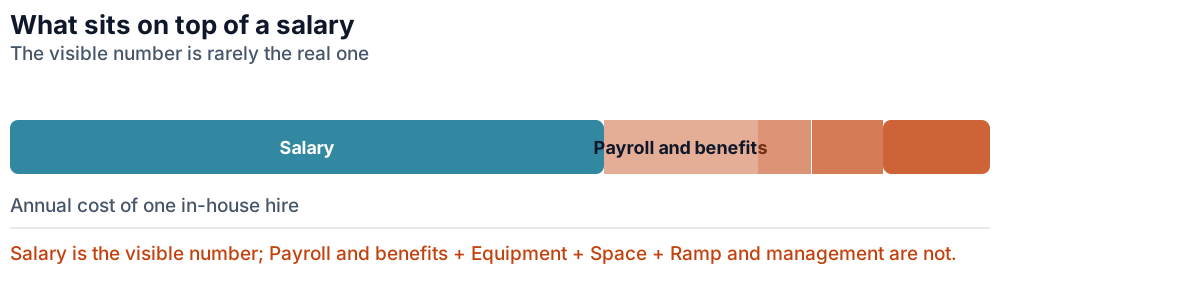
Almost every comparison between an in-house employee and a virtual assistant starts by putting two hourly rates side by side, which is the one comparison guaranteed to mislead you. Salary is the visible portion of an employment cost, and in the United States it is rarely more than two thirds of the total. The rest arrives as payroll taxes, benefits, equipment, software seats, workspace, paid leave and the management time nobody books anywhere.
The comparison that holds up is loaded cost against loaded cost, measured per unit of work delivered. Once you frame it that way the question stops being which option is cheaper and becomes which structure fits the shape of the work, because for full-time, deeply embedded roles the in-house answer often survives the maths perfectly well.
The Real Loaded Cost of an In-House Employee
Build the comparison from your own figures rather than a template, because the gap swings enormously by role and location. The categories below are the ones people forget, and forgetting them is what produces the twenty-per-cent difference that later turns out to be a great deal larger.
| Cost line | In-house employee | Virtual assistant |
|---|---|---|
| Base pay | Salary or hourly | Service fee |
| Payroll tax and insurance | Employer's share, workers' comp, unemployment | None, not your employee |
| Benefits | Health, retirement, paid leave | Carried by the provider |
| Equipment and software | Laptop, phone, seats, desk | Usually theirs, plus your app seats |
| Recruiting | Job ads, screening, your hours | Included in a managed engagement |
| Cover when absent | You absorb it | Managed, backup and replacement |
| Cost when volume drops | Unchanged | Scope can flex |
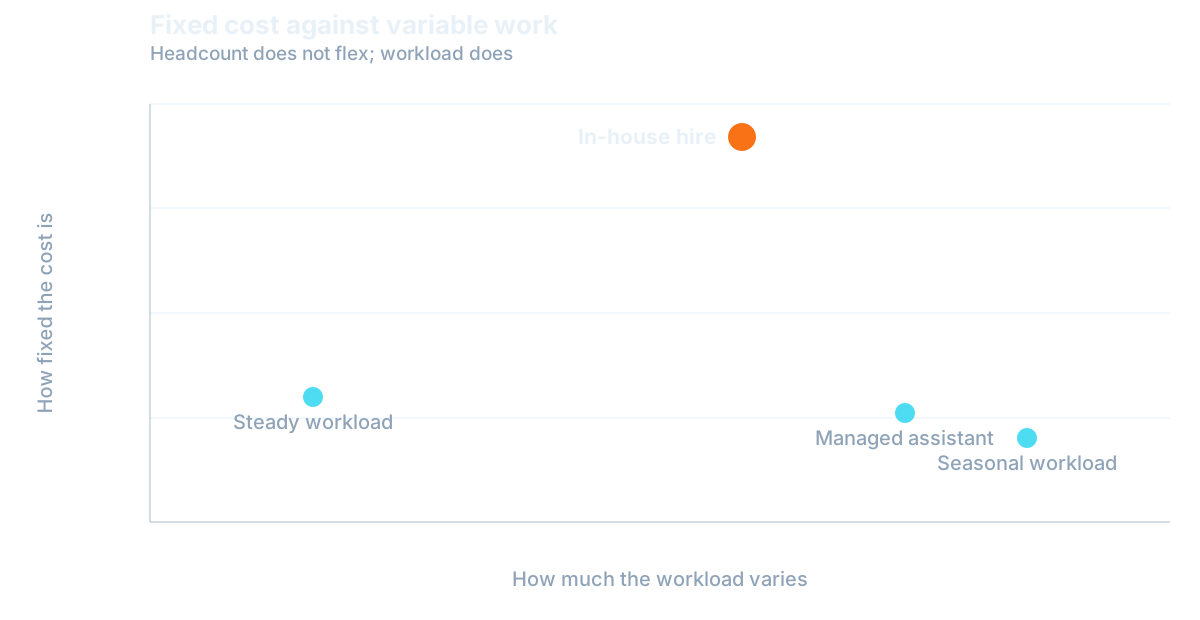
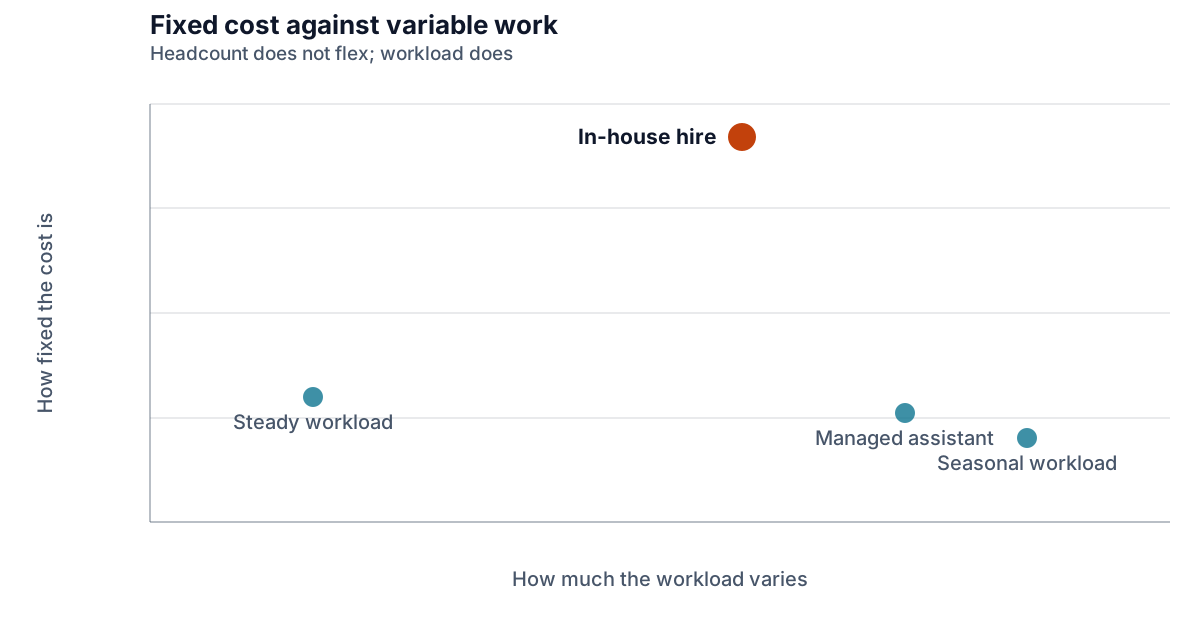
That last row is the one that decides most real cases. An in-house salary is fixed against a workload that is not, so you carry the full cost through your quiet months as well as your busy ones. Whether that matters depends entirely on how steady your volume is, which is a question about your business, not about staffing models.
Where an In-House Hire Wins
There are situations where in-house is straightforwardly the better answer, and any comparison that fails to say so is selling something. If the role needs physical presence, handles work that legally or contractually cannot leave your premises, or requires deep institutional context accumulated over years, an employee is the right structure and the cost difference is worth paying.
The same applies when the work is full-time and stable. The flexibility a virtual arrangement buys you is worth very little if you will never use it, and at that point you are paying a coordination premium for optionality you do not need. Steady, full-time, on-site, sensitive: hire.
Where a Virtual Assistant Wins
The virtual model earns its keep when the work is real but does not fill a week, when volume moves with your season, or when you need capability faster than a hiring cycle can deliver it. It also wins on a dimension that rarely appears in cost comparisons at all: the speed at which you can stop. Ending an engagement is a conversation, whereas ending an employment is a process with legal exposure attached. Deciding which tasks fit this model is the job of working out what to delegate first.
It wins again on coverage. A single in-house administrator who is ill, on leave or resigning leaves a gap you personally fill, which is when you can least afford it. A managed engagement puts that continuity risk on the provider, and continuity is what most owners are buying, which is the whole theme of choosing between a freelancer, a managed VA and an agency.
There is a third structure worth pricing for part of that work. A Digital Employee is AI built for one role's repeatable steps, and it works alongside an in-house hire or a virtual assistant rather than in place of either, taking the rule-bound volume so the person spends their hours on judgement. The ways-to-hire comparison puts the options side by side so you can price the same scope each way.
The Variable Nobody Prices: Undocumented Process
Both models fail in the same way and for the same reason, and it has nothing to do with cost. Undocumented process is the hidden variable. An employee compensates for it by absorbing your context over months of proximity, which feels like the model working while it hides a problem. A remote assistant cannot absorb what was never written down, so the gap surfaces in week one.
This is why owners frequently conclude that virtual did not work for them when in fact the arrangement exposed an existing weakness faster. The fix in both cases is identical: write down the process, define the approval limits, name the escalation path. The difference is only whether you find out immediately or three months in.
There is a second-order effect. Because the gap surfaces immediately with a remote assistant, you get the information early enough to act on it, while the engagement is still small and reversible. An in-house hire who quietly absorbs an undocumented process for a year converts it into a person-shaped dependency, and you discover its true cost on the day they resign.
How to Decide in One Sitting
Work out the loaded annual cost of the in-house version using your real numbers, including the recruiting hours you will spend personally. Then take the same scope and price it as a managed engagement, using our guide to what a virtual assistant costs. If the two land close together, the decision is not financial at all and you should choose on control, presence and permanence instead.
One caution on that exercise: people systematically underestimate the recruiting line, because it is paid in their own hours rather than in cash. Writing the advert, filtering applications, running interviews, checking references and covering the notice period is real work performed by whoever can least afford the interruption. Price it at what an hour of your time is worth and the comparison often moves before you have considered a single benefit.
If they land far apart, ask the harder question before acting: is the work genuinely full-time, or have you assembled a full-time job out of tasks that only add up to twenty hours? That single question redirects more of these decisions than any spreadsheet, because a great many first hires are made for a role that does not yet exist.
Want this handled for you?
We map the work eating your week and match a skilled specialist, typically in 7-14 days.