

Virtual Assistants for Accounting Firms: Surviving Busy Season

Why Accounting Firms use Virtual Assistants for Busy Season?
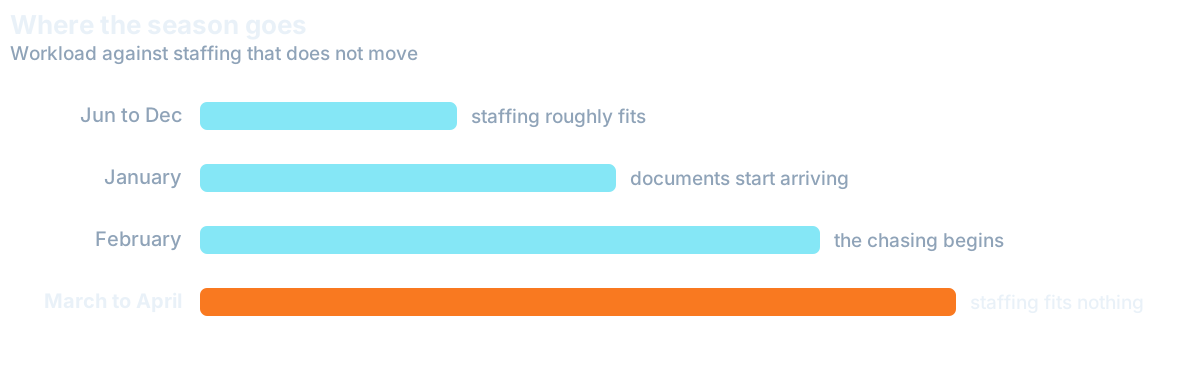
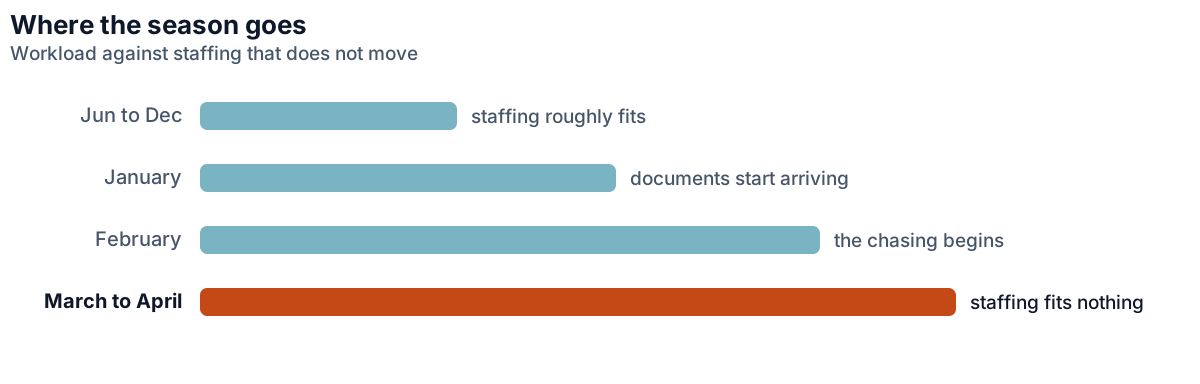
Accounting firms have a workload problem that is unusual in its predictability. For a few months the volume is overwhelming; for the rest of the year it is manageable with the people you have. Hiring year-round staff to cover the peak means carrying that cost through the trough, and hiring temporary staff means training somebody new every year for the period when you have least time to train anyone. That is why virtual assistants for accounting firms have become a busy-season staple.
Flexible capacity suits that shape, and preparation is what makes it work: a firm that brings assistants in during February is training people while drowning, which helps nobody. The firms that get real value hire in the quiet months and arrive at the peak with somebody already fluent in their process.
What a Virtual Assistant for an Accounting Firm Absorbs
The work that transfers well is the substantial administrative layer wrapped around professional judgement, and in most firms that layer is larger than partners realise: chasing clients for missing documents and following up until they arrive, organising and naming records so a preparer is not hunting, data entry and transaction categorisation, reconciliations, preparing draft workpapers, managing the engagement calendar and deadline tracking, and client communication about status and requirements. Much of it overlaps with what a bookkeeping virtual assistant handles day to day.
Document Chasing: The Hidden Constraint
Document chasing deserves particular mention because it is the largest hidden cost in most practices. Work sits not because nobody has capacity but because a client has not sent something, and nobody has time to chase for the fourth time. An assistant whose job includes persistent, polite, scheduled chasing changes throughput more than an additional preparer would, because it addresses the thing holding the work up.
Deadline tracking is worth separating out as its own function. Firms typically hold deadlines across several systems and one partner's memory, and the cost of a missed one is disproportionate to the effort of tracking it. Making that somebody's explicit responsibility, with a single view of what is due when, removes a category of risk that has nothing to do with technical capability.
What must Stay with Licensed Staff?
The boundary here is not negotiable and it is worth writing into the engagement rather than assuming. An unlicensed assistant does not sign returns, does not give tax advice to clients, does not make judgement calls about treatment, and does not represent the firm in a position requiring a credential. Those functions belong to your licensed staff and always will.
What that leaves is still substantial: preparation, organisation, communication about process rather than substance, and everything that gets a file into a state where a professional can exercise judgement efficiently. The rule of thumb that holds up well is that an assistant can do anything that does not require somebody's licence to be on the line, and if you are unsure in a specific case, that uncertainty is itself the answer.
Handling Client Data Properly
Accounting firms hold unusually sensitive information, and the controls need to be real rather than gestural. Access should be scoped per client or per engagement where your systems allow it, so an assistant working one set of files cannot browse the rest. Portal access rather than emailed documents. Named accounts with individual credentials, never shared logins. Written confidentiality terms in the engagement. The same discipline as giving an assistant access safely applies here in full.
Check your professional body's guidance and your insurer's requirements on outsourced support before you start, and check whether client engagement letters require disclosure of third-party involvement: some do. This is a conversation worth having once, properly, rather than discovering the position afterwards. Firms that handle it well typically find the requirements are entirely satisfiable; the ones that get into difficulty are the ones that never asked.
Timing the Hire: Start in the Quiet Months
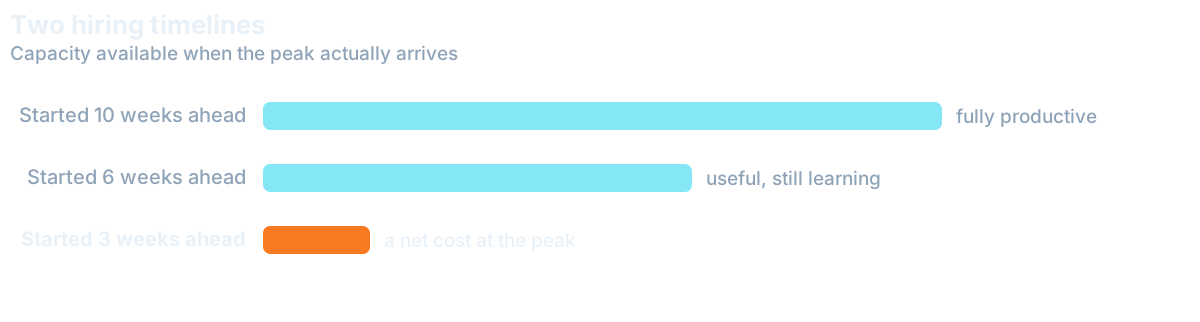
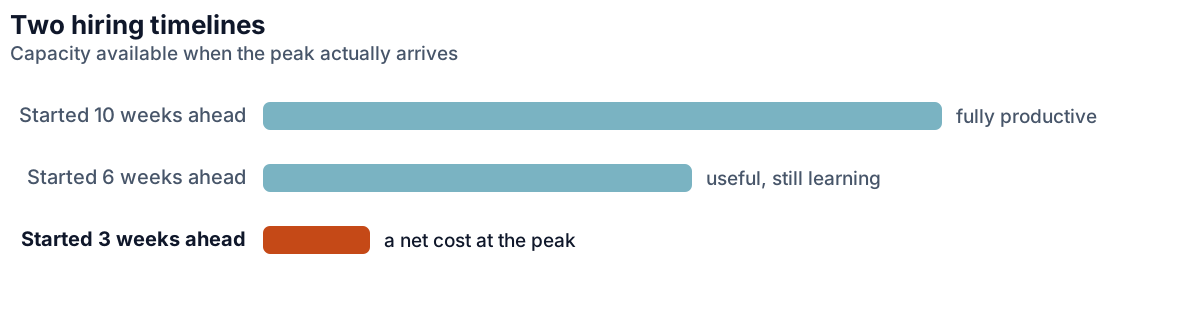
The single highest-leverage decision is when you start, and most firms start too late. An assistant brought in eight to ten weeks before the peak has time to learn your workflow, your document conventions and your clients' habits while somebody still has capacity to teach. The same person brought in three weeks before the peak is a net cost during the period you can least afford one.
The second decision is scope. Firms that hand over the whole administrative layer at once tend to struggle; firms that transfer document chasing first, then organisation, then data entry, then draft preparation, build a working relationship on low-risk work before the pressure arrives. The sequence matters more here than in most industries because the failure window is so unforgiving.
Client communication during the peak is the other thing worth handing over deliberately. Clients ask where their return is, and answering costs a preparer the same interruption whether the question takes thirty seconds or five minutes. Routing status enquiries to somebody who can answer them from the tracking system protects the concentration of the people doing the technical work, which is the scarcest resource in the building during those weeks.
What they do in the Quiet Months
The obvious objection to year-round support is the trough, and it is a fair one. In practice the quiet period is where the work that never gets done otherwise finally happens: cleaning up client records, documenting the processes that live in partners' heads, chasing the receivables that have been outstanding since spring, and building the templates that make the next peak cheaper.
Firms that treat the trough as preparation rather than as idle capacity tend to find each season easier than the last, because the administrative debt does not accumulate. Firms that scale capacity down to nothing between peaks rebuild the same context every year and wonder why the season never gets easier. If your practice runs on this rhythm, see how we staff finance and accounting teams and match trained assistants before the peak.
Want this handled for you?
We map the work eating your week and match a skilled specialist, typically in 7-14 days.