

VA, Freelancer or Agency: Who Carries the Risk?

Virtual Assistant vs Freelancer vs Agency: The Difference is Risk, not Price
These three options get compared on hourly rate, which explains why so many of the resulting decisions go badly. Rate is the least informative difference between them. What separates a freelancer, a managed virtual assistant and an agency is who absorbs the consequences when the work stops: when someone quits, gets ill, underperforms or disappears mid-week.
Every engagement model is a position on that single question, and the price differences follow from it rather than causing it. Once you look at them this way the choice usually becomes obvious, because you already know how much disruption your business can survive.
The Freelancer: You Carry All the Risk
Hiring directly is the cheapest option per hour and the most expensive in every other currency. You do the sourcing, the screening, the interviewing, the onboarding, the training, the quality control and the classification paperwork. When the arrangement ends, you do all of it again from the beginning, and the institutional knowledge leaves with them. Doing that screening well is a real skill in itself, covered in how to find and vet a virtual assistant.
This is a good fit for well-defined, bounded projects where you can specify the output precisely and judge it on delivery: a one-off migration, a design job, a defined build. It is a poor fit for ongoing operational work where continuity is the entire point, because the model has no answer at all to the day your freelancer stops replying.
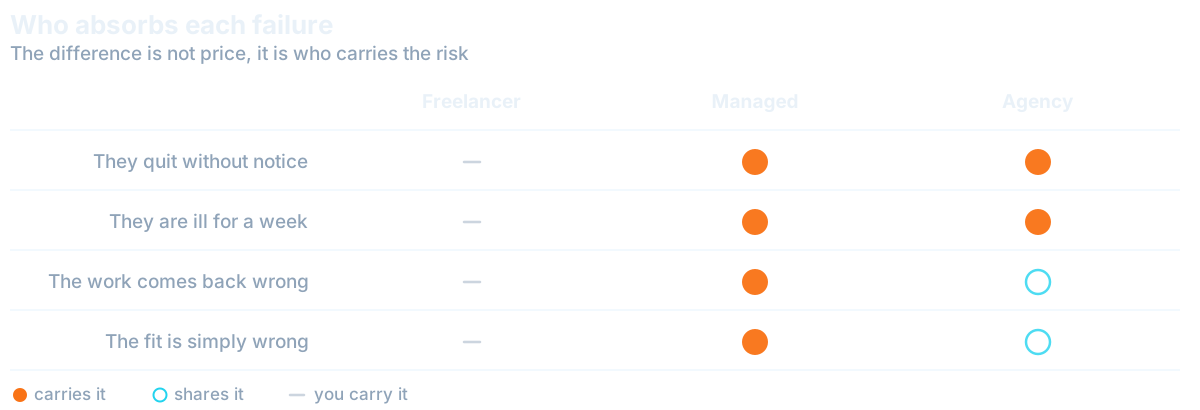
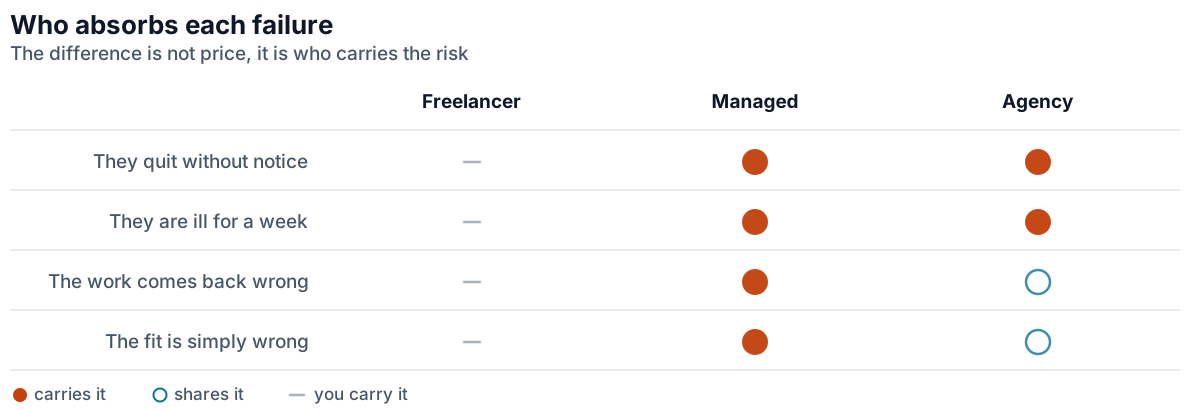
The model is often dismissed unfairly: an excellent freelancer working on well-specified work is one of the best value arrangements in business. Where it goes wrong is using a project structure for operational work and then being surprised when it offers no continuity. Match the structure to the work and the model performs as designed.
The Managed Virtual Assistant: The Provider Carries Continuity
A managed engagement sits between the two extremes. You get a named assistant who learns your business and works only with you, but the recruiting, vetting, oversight and replacement all sit with the provider. You keep the working relationship and the day-to-day direction; you hand over the staffing risk.
The trade is real: you pay more per hour than hiring directly, and you accept that the provider's process sits between you and the labour market. In exchange, an assistant who leaves is the provider's problem to solve rather than a hole in your week, and someone other than you is responsible for the standard of the work.
The other thing a managed model buys is a second opinion on the work itself. When only you and the assistant can see what is happening, quality drifts slowly and nobody notices until a client does. An account manager who reviews the engagement independently catches that drift while it is still a conversation rather than an apology, and that oversight is a large part of what separates the two middle options in practice.
The Agency: Capacity without a Face
An agency sells output rather than a person. Work is distributed across a pool, which makes it resilient to any individual's absence and easy to scale up or down quickly. For bounded, repeatable, specification-driven work this is efficient and often the right answer.
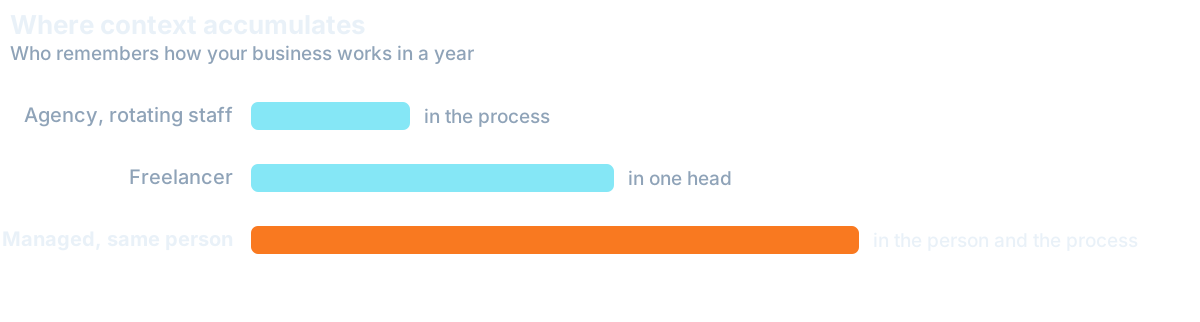
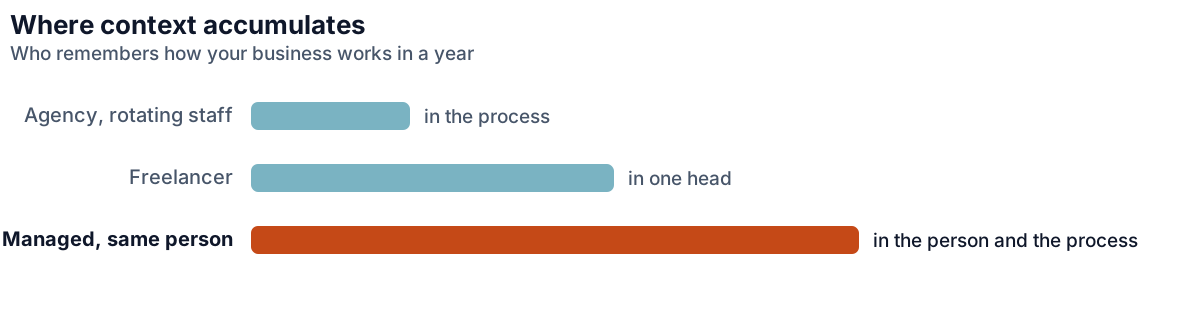
Its weakness is the mirror of its strength. Because no single person owns your account, context does not accumulate. Nobody notices that a particular client always calls on Fridays, or that one vendor needs chasing twice. For operational work where the value is that accumulated judgement, a pool model quietly underdelivers while appearing to function.
Virtual Assistant vs Freelancer vs Agency, Side by Side
The table below compares them on the dimensions that determine outcomes rather than the ones that appear in pricing pages. Read the risk rows first, since those are the ones you will feel.
| Freelancer | Managed VA | Agency | |
|---|---|---|---|
| Who sources and vets | You | Provider | Provider |
| Who trains | You | Provider, then you on specifics | Provider |
| Cover for absence | None | Provider supplies backup | Pool absorbs it |
| If they leave | Start over | Provider replaces | Usually invisible to you |
| Context accumulation | High, then lost | High, and retained | Low by design |
| Cost per hour | Lowest | Middle | Varies, often highest |
| Best for | Bounded projects | Ongoing operational work | Repeatable specified output |
One more distinction worth holding onto: these models fail at different speeds. A freelancer arrangement tends to fail abruptly, the replies stop and you find out at the worst possible moment. An agency fails gradually and quietly, as context that never accumulated shows up in work that is technically correct but subtly wrong. A managed engagement fails visibly, because someone other than you is watching for it. Knowing which failure mode you can absorb is a better guide than any rate card.
How to Choose without Regretting it
Start from the work rather than the budget. If you can write a specification and judge the result on delivery, a freelancer or an agency will serve you well and the cheaper option is the better one. If the value depends on someone knowing your business, your clients, your exceptions, your standards, then continuity is the product and you should buy the model that guarantees it. Either way, work out what a virtual assistant costs across a full year before comparing headline rates.
One slice of operational work now has a fourth answer. When a task is the same steps every time, with a clear input and a result you can check, a Digital Employee can run it inside your own tools, and the continuity question changes shape: nothing resigns, but someone still has to look after it, whether that is HireTrainVA, someone on your team, or your VA. The three ways to hire sets a virtual assistant, a Digital Employee and a Hybrid Team side by side, read the same risk-first way as the table above.
A useful test: imagine the person you engage becomes unavailable tomorrow with no warning. Write down what happens next, hour by hour, in your business. If that account is short and untroubling, the cheaper model is fine. If it involves you personally covering client communication for an unknown number of weeks, you have just described the thing you should be buying, and the rate difference is the price of not living through it.
The expensive mistake is using a project model for operational work because the hourly rate looked better. It reads as a saving for a few months and then costs you a full re-onboarding, usually at the least convenient moment. Whichever model you choose, ask what happens when the person disappears, and take the answer seriously rather than treating it as a formality.
Want this handled for you?
We map the work eating your week and match a skilled specialist, typically in 7-14 days.