

Virtual Assistants for Coaches and Consultants: Protecting the Calendar

Why Coaches and Consultants use Virtual Assistants?
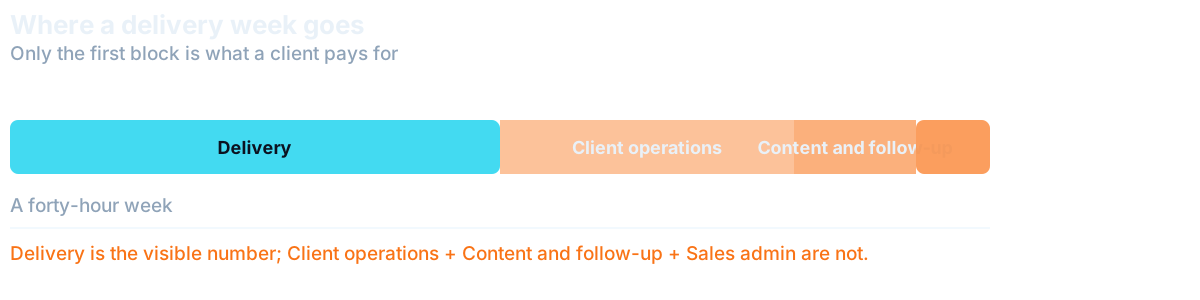
Most businesses lose money to administration indirectly. For coaches and consultants the loss is direct, because delivery hours are the product and every hour absorbed by scheduling, invoicing or follow-up is inventory that cannot be sold. A practice with twenty available delivery hours a week that spends six on administration has lost thirty per cent of its capacity. That is the whole case for virtual assistants for coaches and consultants.
That arithmetic makes the delegation case unusually clean, and it also explains why so many practitioners delegate late. The administrative load arrives one small task at a time, each individually too trivial to justify hiring anyone, until it has quietly consumed a third of the week.
Client Operations, Which is Most of it
The largest block is the machinery around each client relationship: scheduling and rescheduling, sending reminders, preparing materials before a session, capturing notes and actions afterwards, tracking who is due for what, chasing outstanding items, handling onboarding paperwork and payment collection. This is the core of what a virtual executive assistant owns.
Rescheduling in particular is worth naming because it is disproportionately expensive. A cancelled session costs the hour and the negotiation to replace it, and a practitioner handling that themselves does so between other sessions, which fragments the day further. An assistant owning the calendar turns a disruptive exchange into something that resolves without touching your attention at all.

Invoicing and payment collection deserve early attention too. Practitioners are often uncomfortable chasing their own money, particularly from clients they have a coaching relationship with, and that discomfort produces long payment cycles. Routing it through somebody else removes the awkwardness entirely and usually shortens collection substantially.
Content and the Follow-Up Nobody does
Most coaches and consultants produce material constantly, session frameworks, worksheets, talks, posts, newsletters, and publish a fraction of it. The gap is the production work that sits between having something to say and it existing somewhere a client can use it.
An assistant closes that gap: turning recordings into notes and summaries, formatting worksheets, scheduling newsletters, repurposing a talk into several posts, and maintaining whatever library your clients draw on. The same applies to follow-up sequences after a discovery call or a programme ending, which almost everyone intends to run and almost nobody runs consistently.
Testimonials and case material belong here too, and almost nobody collects them systematically. The right moment to ask is immediately after a client has said something appreciative, and that moment passes unrecorded when the practitioner is moving straight into the next session. An assistant who notices and follows up turns ordinary satisfaction into material you can use.
The Sales Layer Around Discovery Calls
The pipeline for most practices is a small number of high-value conversations, which makes the administration around them worth doing properly. Booking discovery calls, sending confirmations and reminders so people attend, providing pre-call information, following up afterwards, sending proposals, and chasing the ones that went quiet.
Following up on quiet prospects is the piece most practitioners avoid, usually because it feels like chasing rather than serving. It is also where a meaningful share of business closes. Handing it to somebody who can do it on a schedule and without the emotional weight typically produces more return than any change to the pitch itself.
Group programmes and cohorts add a coordination layer worth mentioning. Managing a cohort, access, reminders, materials, the community, the people falling behind, is a defined operational job, and practitioners who run programmes without support tend to find the administration scales faster than the revenue does.
What should Never Leave your Desk?
The delivery relationship stays entirely with you, and so does anything that touches the substance of the work: the coaching itself, the diagnosis, the advice, the judgement a client is paying for. That should be obvious and it is worth stating because the boundary blurs at the edges: an assistant summarising a session is administration, while an assistant answering a client's question about their situation is delivery.
Client confidentiality also deserves more care than most practices give it. Session notes and client circumstances are sensitive even when no regulation applies, and clients rarely expect a third party to have access. Write the confidentiality terms down, scope access deliberately, and if your work touches anything clinical or regulated, check your professional body's position before anyone else sees a note.


Onboarding is the other early win. A new client needs contracts, payment setup, intake forms, scheduling and access to whatever materials they have bought, and doing that manually each time is both slow and inconsistent. Once it is a documented sequence, it runs without you and every client gets the same experience rather than whichever version you had time for that week.
The Order to Delegate in
Start with scheduling, because it is the most disruptive to your day and the easiest to specify. Give the assistant the calendar rules, the buffer preferences and the rescheduling authority, and a category of interruption disappears within a fortnight. This is the same order-of-operations for delegating that works in any practice.
Then client operations, reminders, materials, notes, chasing. Then content production, once they understand your voice well enough. Sales follow-up last, because it needs the most context about how you talk to prospects and carries the highest cost when it sounds wrong.
Practitioners who reverse this order, handing over sales follow-up first because it feels most valuable, generally struggle: the assistant has neither the context nor the working relationship to handle a prospect well, and the early failure makes everyone reluctant to try the transfers that would have been straightforward. When you are ready, see the full range of virtual assistant roles we place and support.
Want this handled for you?
We map the work eating your week and match a skilled specialist, typically in 7-14 days.