

Virtual Assistants for Insurance Agencies: Protecting the Renewal Book

Why Insurance Agencies use Virtual Assistants to Protect the Book?
An insurance agency's value sits in its book, and a book erodes quietly. Policies lapse not because a client decided to leave but because nobody contacted them in time, a payment failed and went unnoticed, or a renewal arrived while the producer was writing new business. Each individual loss is small enough to be invisible and they compound annually. This is the gap virtual assistants for insurance agencies are hired to close.
This makes agencies an unusually clear case for delegation, because the highest-value work, consistent, scheduled, unglamorous contact, is the work that gets displaced by whatever is urgent. Producers are rewarded for writing new business and rarely for preventing quiet attrition, which is why the second needs to belong to somebody whose job it is.
The Licensing Line, Which is not Negotiable
Insurance is a licensed activity and the boundary is firm: an unlicensed assistant must not advise on coverage, recommend a product, quote, bind, or discuss anything that constitutes a coverage opinion. State rules vary in their detail, so confirm your position with your compliance resource, but that core boundary holds broadly.
What remains is still most of the administrative load. The practical test that works day to day is whether the assistant is conveying information or forming a judgement. Telling a client their renewal date, what documents are needed, or that a payment did not process is conveying. Telling them whether a policy covers something, or which option suits them better, is forming a judgement, and that goes to a licensed producer.

Payment failures deserve their own watch. A card that expires quietly produces a lapse that nobody intended, and the client usually does not discover it until they need the policy. Monitoring failed payments and contacting clients promptly is trivial work that prevents an entirely avoidable and expensive category of loss.
Why Renewals are the First Thing to Delegate?
Renewal management is process, not judgement, which makes it both delegable and high-return. It means running the renewal calendar, contacting clients well before expiry, gathering updated information, flagging anything that needs a producer's attention, confirming payment details are current, and chasing until the renewal is complete rather than until the first message is sent.
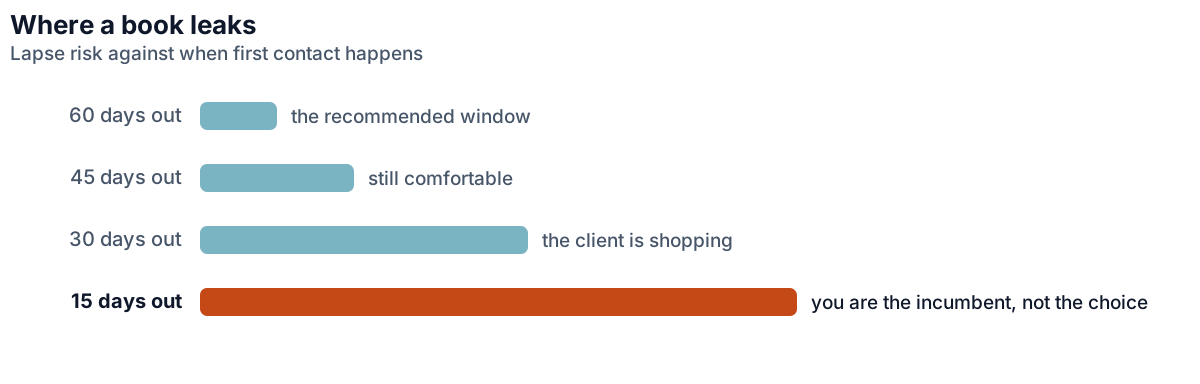
Timing does most of the work. A client contacted sixty days out has room to ask questions and make decisions calmly; the same client contacted a fortnight before expiry is deciding under pressure and is far more likely to shop around. The difference between those two conversations is entirely a scheduling matter, and scheduling is the thing that slips first when everybody is busy.
Service Work and the Endorsement Queue
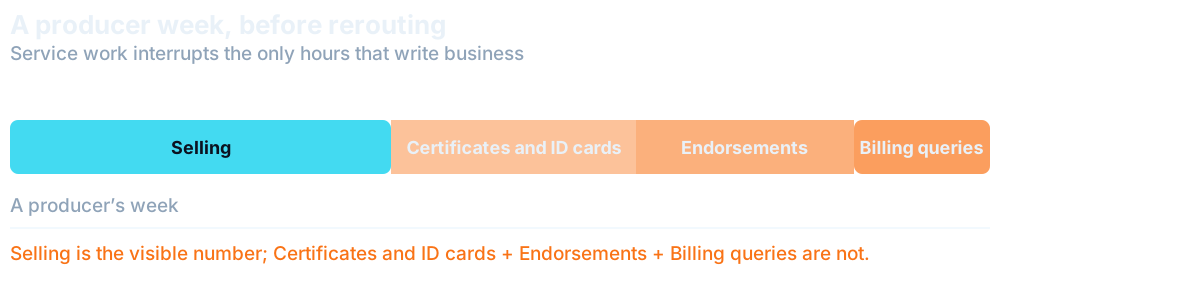
Beyond renewals sits the steady stream of service requests: certificates of insurance, endorsement requests, ID cards, address and vehicle changes, adding or removing a driver, proof of coverage for a lender. Individually trivial, collectively substantial, and almost entirely process once the carrier workflows are documented. It is standard administrative assistant work, run against carrier systems.
Certificates deserve a specific mention because they are frequently urgent for the client and low-value for the agency. A contractor who cannot start work without a certificate needs it today, and an agency that turns those around within the hour earns loyalty out of proportion to the effort. That responsiveness is straightforward to deliver when somebody owns the queue and nearly impossible when it competes with a producer's day.
Carrier portals are the other place time disappears. Every carrier has its own system, its own quirks and its own turnaround, and navigating them is the sort of learned, repetitive knowledge that transfers well to somebody who works in them daily rather than occasionally.
Claims Support, within Limits
Claims are where clients most need the agency and where the licensing boundary matters most. An assistant can take first notice of loss details, submit the claim to the carrier, track its status, chase the adjuster for updates, and keep the client informed about where things stand procedurally.
What they cannot do is interpret coverage, offer an opinion on whether something will be paid, or advise the client on how to present a claim. That distinction is easy to state and hard in the moment, because a distressed client asks those questions. The script matters here, and so does making it plain to the assistant that declining to answer is the correct behaviour rather than a failure to help.

Cross-selling sits adjacent to service work and is frequently missed. An assistant processing an endorsement can see that a client with a commercial policy has no umbrella cover, and flag it to a producer. They surface the opportunity for somebody licensed to act on, which is the right division of labour.
Data Hygiene, Which Nobody Wants and Everybody Needs
Agency management systems degrade steadily: duplicate contacts, stale phone numbers, policies attached to the wrong entity, missing effective dates, expired certificates still listed as current. None of it causes a visible failure until the day it does, usually when somebody cannot be contacted about a renewal.
This is ideal delegated work because it is measurable, low-risk and otherwise never gets done. An assistant working steadily through record cleanup produces an improvement that is invisible week to week and shows up as fewer missed renewals a year later, which is the same shape as the listing work in e-commerce and neglected for the same reason. If protecting the book is the priority, see how we staff virtual assistant roles for agencies.
Want this handled for you?
We map the work eating your week and match a skilled specialist, typically in 7-14 days.