

What Is an AI Employee? The Digital Employee, Explained

What Is an AI Employee?
An AI Employee is AI that owns one job in your business from start to finish, such as following up on new leads or chasing overdue invoices. At HireTrainVA we call it a Digital Employee: it has a role, works inside the tools you already use, and reports against goals you set.
Be a little suspicious of the label. "AI Employee" is a marketing name, not a technical standard, and vendors stick it on everything from a chat window to a real worker. It is not a legal employee either, and it has no judgment of its own to lean on when something odd turns up.
So the useful question is not what it is called. It is whether the thing can do a defined job without you standing over it, and whether you can see exactly what it did. If you have been burned hiring a virtual assistant who needed constant hand-holding, you already know that test. The rest of this post applies it to AI Employees for small business owners: what the work looks like, who watches it, and where a person is still the right hire.
What an AI Employee Does in a Normal Week
A normal week is the same few jobs, done the same way every time. That is the point. A Digital Employee is built for one role, so its week is narrow and predictable, and the dull repetition is exactly the part you want off your plate.
Here is what that looks like across the roles we build, using the things owners tell us eat their time:
- Building and checking lead lists against your ideal customer, then loading them into your CRM
- Researching each lead and drafting outreach in your voice, sent once you say go
- Triaging your inbox, drafting replies and protecting your calendar
- Drafting social posts and newsletters and queueing them for approval
- Sending polite reminders on overdue invoices and logging payment promises
- Keeping tasks current, chasing blockers and writing the weekly report
Your part of the week is small. Work that needs a decision lands in an Inbox with three buttons: Approve, Send back with a note, or Take over. When you send something back with a note, the correction carries forward, so you are not fixing the same thing twice.
At the end of the week it reports on a KPI board, with proof of the work: what it drafted, what it sent, what is waiting on you. If you cannot see that, you do not have an employee. You have a hope.
AI Employee vs Chatbot vs Software
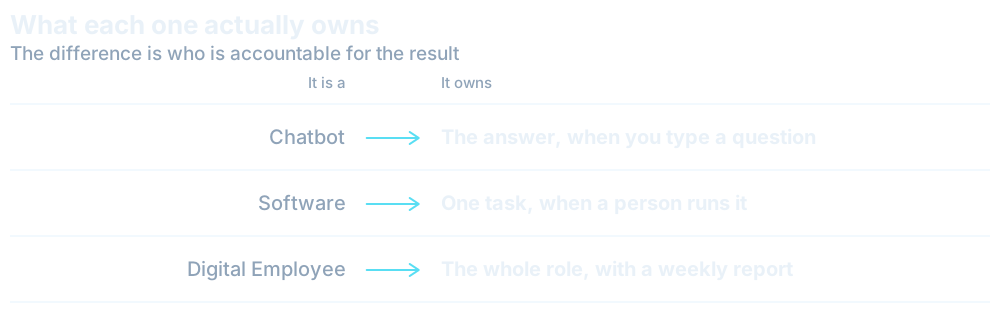
Chatbots, software and Digital Employees get lumped together, and the difference is who owns the outcome. A chatbot answers questions in a window and waits for you to type. Software does one task when a person runs it. A Digital Employee holds a role and is accountable for the result.
Think about what happens when nobody touches it for a week. The chatbot sits idle. The software sits idle. A Digital Employee keeps working inside its rules, because the work is its job, and it tells you what happened.
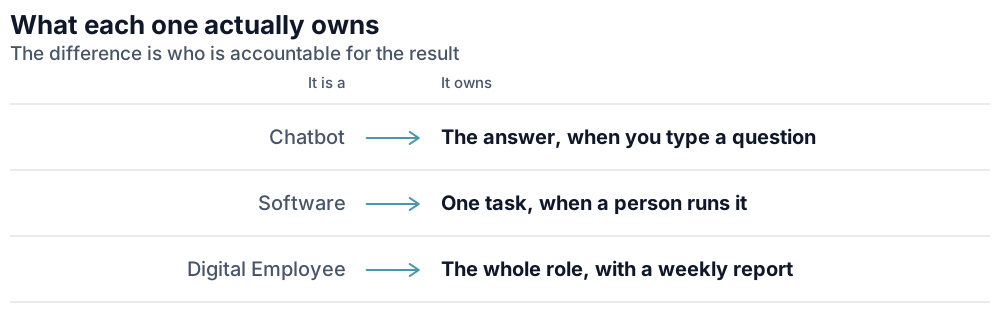
None of this makes a chatbot a bad idea. For simple, high-volume questions on a website, a plain chatbot can be the most efficient answer, and it does not need a job title. The trouble starts when a tool that answers questions gets sold as a worker that does jobs. Ask any vendor one thing: on Friday, who owns the result, and where is the proof?
Who Supervises It, and How It Runs on Its Own
Somebody always looks after a Digital Employee. Who depends on you: HireTrainVA, someone on your team, or your VA. We build and set up every one, so you are not left configuring AI on a Sunday night.
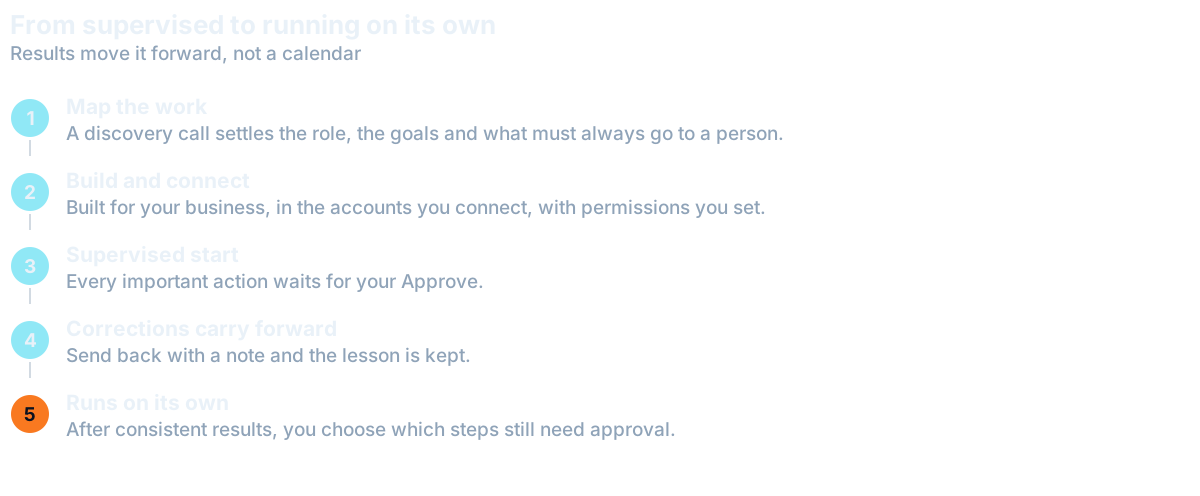
It starts supervised. Every important action waits for your Approve while it learns how you work. Once it delivers consistent results, it runs on its own, and you choose which steps still need approval. There is no fixed number of weeks here. The trigger is results, not a calendar.
Running on its own does not mean running loose. Anything that leaves your business waits for your Approve unless your rules let it through. Approval rules are set per action, every action is kept in an audit trail, and a task that fails three times pauses itself and alerts its owner.
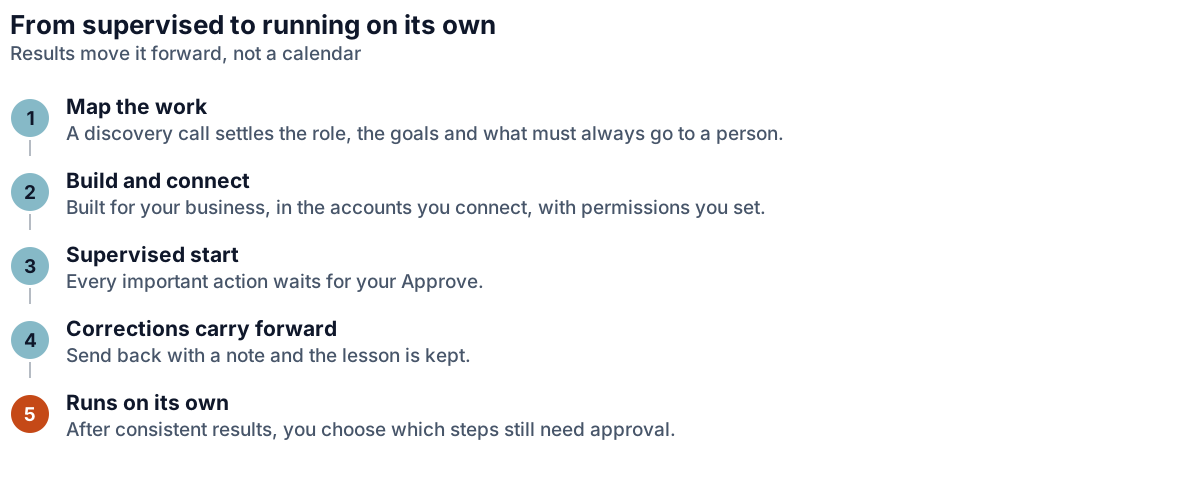
The steps above are the whole path. The part owners skip is the second one: a Digital Employee is built on demand for one business, because every company's tools, rules and customers are different. There is no off-the-shelf version to switch on.
What an AI Employee Never Does
The limits matter more than the features, so they are worth stating plainly. A Digital Employee works only in the accounts you connect, with the permissions you set. That covers tools such as Gmail and Google Workspace, Microsoft 365, HubSpot, GoHighLevel, Slack and Calendly. Past that line, it does not go.
- It never gives legal, medical, tax or financial advice. Those decisions stay with you and your advisers.
- It never sends anything outside your rules. Nothing leaves your business unless your rules allow it.
- It never takes over the relationship. Live calls, an upset client, an objection or an exception go to a person.
- It never works out of sight. Every action is logged and the weekly report shows the work.
In medical and legal practices the line is tighter still. There, a Digital Employee only assists human roles with mechanical tasks. It never holds a critical role.
How an AI Employee Works Alongside People
For most owners we recommend aHybrid Team: people and Digital Employees on the same job. People keep the calls, the judgment and the relationships. Digital Employees take the repeatable work, such as research, drafts, follow-ups and reporting. Neither side has a fixed headcount.
The pairings are by role, not by bundle. Here is how a few of them split the work, taken from our typical pairings:
| The job | The Digital Employee does | The person keeps |
|---|---|---|
| Lead generation | Lead Researcher builds the list, Outbound SDR drafts the outreach | Calling everyone who replies, objections |
| Bookkeeping | Invoice Chaser drafts reminders and logs payment promises | Reconciling, disputes, payment plans |
| Executive support | Inbox Zero Assistant drafts the replies | Anything that needs a person |
| Project management | Project Coordinator tracks work and prepares status updates | Coordinating people, solving issues |
Notice that nobody in that table is replaced. The Digital Employee does the half that follows the same steps, and the person spends the day on the half that does not. The bookkeeping Hybrid Team shows one pairing step by step, including who approves what goes to a customer.
The Starting Roles for an AI Employee
You do not hire a general AI and hope it finds work. You pick a role. These six are the ones owners ask for first, and we build each one on demand for your business:
- Marketing Director plans the month against your goals, then writes, checks and schedules the work.
- Chief of Staff coordinates, triages and briefs you.
- Social Media Manager drafts posts and queues them for your approval.
- Outbound SDR researches leads and drafts outreach in your voice.
- Lead Researcher builds and checks lead lists, then loads them into your CRM.
- Project Coordinator keeps tasks current, chases blockers and writes the weekly report.
Others are built on demand too, including an Inbox Zero Assistant, Invoice Chaser, Speed-to-Lead Responder and Appointment Setter. Start with one and add more as it earns your trust. The full list lives on the Digital Employees page.
When a Virtual Assistant Is Still the Better Hire
Plenty of work should go to a person, and we say so on every discovery call. If the job needs calls, judgment or relationships, hire a person. If the steps change every time, or you cannot describe a standard you could check each week, a Digital Employee will struggle and a good virtual assistant will not.
A virtual assistant is the better hire for an executive assistant role that lives on your calendar and your confidential decisions, for a client who is angry and needs to be heard, and for anything where a read of the room decides the outcome. Our VAs come from the top 1-2% of applicants, are managed by a dedicated account manager, come with a 2-week replacement guarantee and no locked-in contracts. Most clients meet their matched VA within 7-14 days.
Which one fits depends on the work, not the label. Compare the three ways to hire side by side, or read what to delegate first if you are still deciding what to hand off at all.
The fastest way to find out is to stop guessing. Run the Founder's X-Ray, a free 15-minute scan that maps the tasks in your week and says which ones fit a virtual assistant, a Digital Employee or both. Bring the result to a discovery call and pick your first role from real data.
Questions Owners Ask
What is an AI Employee?
An AI Employee is AI that owns one job in your business from start to finish, such as following up on leads or chasing overdue invoices. We call ours a Digital Employee. It works inside the tools you already use, reports weekly against your goals, and checks with you before anything important goes out.
How is an AI Employee different from a chatbot?
A chatbot answers questions in a window and waits for you to type. A Digital Employee holds one role, works inside your email, CRM and calendar, and reports every week against the KPIs you set. The chatbot owns the answer. The Digital Employee owns the job and shows proof of the work.
Who supervises an AI Employee?
You choose who looks after each Digital Employee: HireTrainVA, someone on your team, or your VA. It starts supervised, with important actions waiting for approval. Once it delivers consistent results it runs on its own, and you decide which steps still need your Approve. A task that fails three times pauses itself.
Will an AI Employee replace my virtual assistant?
No, and we do not sell it that way. A Digital Employee takes the repeatable work: research, drafts, follow-ups and reporting. Your virtual assistant keeps the calls, the judgment and the relationships, and spends more of the day on them. Work that needs a read of the room stays with a person.
Want this handled for you?
We map the work eating your week and match a skilled specialist, typically in 7-14 days.