

AI Employee or Virtual Assistant: Which Work Goes Where?

Virtual Assistant vs AI: Which One Gets the Work?
Give judgment, relationships and anything that commits your business to a person. Give repeatable, rule-based work to a Digital Employee, also called an AI Employee. When one job has both halves, put both on it. That is a Hybrid Team, and it is how most jobs actually split.
The search "virtual assistant vs ai" treats this as a contest. It is not one. A good virtual assistant and a well-built Digital Employee are good at different things, and the owners who get burned are the ones who hand the wrong half to the wrong one.
The terms matter here, because they get mixed up. A chatbot answers a question when someone asks it. A typical AI tool helps a person do one task a little faster. A Digital Employee owns a whole recurring job, like triaging an inbox or chasing invoices, inside the tools you already use, and it checks with you before anything important goes out. A virtual assistant is a person: recruited for the role, managed by a dedicated account manager, and able to do what no rule covers.
So the useful question is not which one to hire. It is which parts of your week belong to which. Here is how we draw the line.
The Rule for Splitting the Work
We use one rule, and it fits on a sticky note. People keep three things. Digital Employees take the rest, as long as the work is repeatable and the rules can be written down.
- Judgment: anything where the right answer depends on context nobody wrote down.
- Relationships: the call with an upset client, the negotiation, the follow-up that needs warmth.
- Commitments: anything that spends money, makes a promise or goes out under your name and is hard to take back.
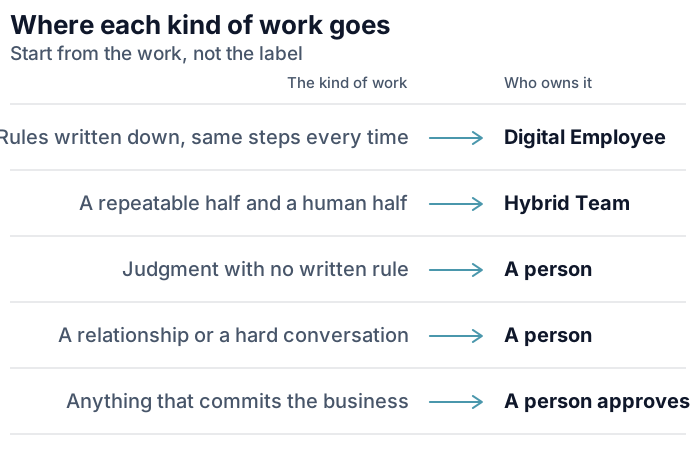
Notice what the third line does. A Digital Employee can draft the quote, the reminder or the reply. Whether it goes out is a person's call, or yours, on the steps you choose. That is how a Digital Employee starts: supervised, with you approving. Once it delivers consistent results it runs on its own, and you decide which steps still need a yes.
This is also why we put people first. A Digital Employee does not know your best client is going through a bad quarter. Your VA might, because your VA has been in that account every week.
Task by Task: Eight Common Jobs
Here are eight common jobs, with the role on each side. The Digital Employee names are the roles we build; the people are the virtual assistant roles we recruit and manage.
| Job | The person | The Digital Employee | Best fit |
|---|---|---|---|
| Inbox | Executive Assistant decides what matters and answers the sensitive mail | Inbox Zero Assistant sorts and drafts replies | Hybrid Team |
| Calendar | Executive Assistant settles the trade-offs and the VIP requests | Calendar Concierge books, confirms and protects your time | Mostly Digital Employee |
| Lead research | Lead Generation VA reviews the list | Lead Researcher builds and checks it | Mostly Digital Employee |
| Outreach | Lead Generation VA owns the angle and the replies | Outbound SDR drafts first emails, sent once you say go | Hybrid Team |
| Appointment setting | Appointment Setter calls and handles hesitation | Speed-to-Lead Responder answers new inquiries at once | Hybrid Team |
| Bookkeeping | Bookkeeper reconciles and handles disputes | Invoice Chaser sends reminders and logs replies | Hybrid Team |
| Customer support | Customer Support VA holds the conversations | Knowledge Base Writer keeps the answers current | People lead |
| Social media | Social Media VA publishes and engages | Social Media Manager drafts and queues posts | Hybrid Team |
Read the last column as a starting point, not a ruling. Only two rows go mostly to a Digital Employee, because those jobs are almost all rules. Customer support goes the other way: the customer is a person, and a hard case needs one. Everything else has a repeatable half and a human half.
One more boundary. A Digital Employee never gives legal, medical, tax or financial advice. In medical and legal offices it only assists the human roles with mechanical tasks, never the critical ones.
What It Costs When You Get It Wrong
Owners get burned in both directions, so it is worth naming each one.
Too Much to an AI Employee
A rule does not know it is looking at an exception. Give a Digital Employee a job that needs judgment and it will follow the rule anyway: the polite reminder lands on a client who is mid-dispute, or a reply reads fine and answers the wrong question. The cost is trust. A customer remembers the one message that missed the point, and you spend a week repairing it.
The guard is the supervised start and the approval steps. Anything that leaves your business waits for a yes until you decide it no longer needs one.
Too Much to a Person
The opposite mistake is quieter. You pay a skilled person to work a checklist. Follow-ups slip on a busy Friday, a 9pm inquiry waits until morning, and the weekly report is late again. The cost is the hours, and also the person: a strong VA stuck on rote work is not growing, and not using what you recruited them for.
The pattern in both cases is the same. The work and the worker did not match. That is why we start from the work, not the label.
Three Questions to Test Any Task
If you are asking "should I hire a virtual assistant or use AI" about a specific task, run it through three questions. They take a couple of minutes per task, and they are more reliable than a gut call.
- Are the rules written down? If you can put the steps in a one-screen SOP, a Digital Employee can follow them. If you can only say "I know it when I see it", that is judgment, and it belongs to a person. Our guide to writing an SOP your VA will follow works for both.
- How often does it repeat? Daily or weekly work with real volume is where a Digital Employee earns its keep. A task that comes up twice a quarter is usually cheaper to hand to a person.
- What happens on an exception? Picture the strangest case you have seen. If a person would just handle it, fine. If the strange case is a lost client or a legal problem, a person must see it first.
Three clear yeses means a Digital Employee. Rules written down but exceptions that matter means a Hybrid Team. No written rules means a person, and probably the first task to document before you hand it off. For the order to start in, see what to delegate first.
How Hybrid Teams Pair Up
When a job has both halves, a Hybrid Team puts a person and a Digital Employee on it together. These are the typical pairings. There is no fixed count on either side, so you can add a person or a Digital Employee as the work grows.
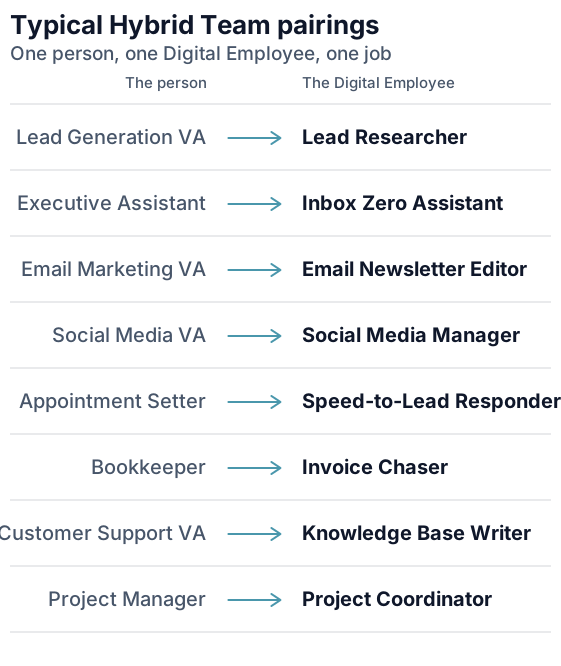
Take bookkeeping as the worked example. The Hybrid Team for bookkeeping pairs a Bookkeeper VA with an Invoice Chaser. The Invoice Chaser runs the same daily check against your open invoices and drafts each reminder, friendly at first and firmer as the invoice ages. The Bookkeeper handles reconciliation, disputes and payment plans. A reminder only goes to a customer after an Approve, from your Bookkeeper or from you, unless your rules let it through.
Who looks after a Digital Employee depends on you. It can be HireTrainVA, someone on your team, or your VA. You are not forced to take on a new thing to manage.
How Our VAs Work With AI Employees
We are a virtual assistant company first, and we mean that. Every VA we place arrives ready for the role and is coached under our management, with a dedicated account manager and weekly scorecards. Only the top 1-2% of applicants qualify, and each one is scored on seven measured dimensions before you meet them. Most clients meet their matched VA within 7-14 days.
The VAs who sit on Hybrid Teams are also trained to work with Digital Employees. In practice that means a few concrete things:
- They read the Digital Employee's drafts and use the three buttons: Approve, Send back with a note, or Take over.
- They handle the cases the rules cannot, such as a dispute, an upset customer or an odd request.
- They send corrections back, and every correction carries forward.
The Digital Employee reports weekly on a KPI board, with proof of the work, so you can see what it did and what it missed. The VA is the person who knows your business well enough to judge it.
Where to Start This Week
Pick one job that eats your week and run it through the three questions above. If you want a wider view, the Founder's X-Ray is a free 15-minute scan that maps your week and says which tasks fit a virtual assistant, a Digital Employee or both.
Then compare your options side by side on our ways to hire page. When you are ready to talk it through, book the free discovery call, bring the one job you picked, and we will tell you which half goes where.
Questions Owners Ask
Can AI replace a virtual assistant?
Not for the whole job. A Digital Employee, also called an AI Employee, can take repeatable, rule-based work such as sorting an inbox or chasing invoices. It does not replace the judgment, the relationships or the decisions that commit your business. Those stay with a person, which is why most jobs work best as a Hybrid Team.
What is the difference between an AI Employee and a chatbot?
A chatbot answers a question when someone asks it. A Digital Employee owns one recurring job from start to finish, such as following up every new lead, inside the tools you already use. It reports results weekly on a KPI board and checks with you before anything important goes out.
Which tasks should go to an AI Employee and which to a person?
Give repeatable work with written rules and real volume to a Digital Employee: research, drafts, reminders and reports. Give judgment, relationships and anything that commits the business to a person. When one job has both halves, such as bookkeeping or appointment setting, put a person and a Digital Employee on it together.
Should I hire a virtual assistant or use AI?
Start from the work. If the task has no written rules or needs a conversation, hire a person. If it follows the same steps every time, a Digital Employee fits. If it has both, build a Hybrid Team. A free 45-minute discovery call with us maps the job and says which fits.
Want this handled for you?
We map the work eating your week and match a skilled specialist, typically in 7-14 days.