

Customer Service Virtual Assistants: Where They Help and Where They Hurt

Can you Safely Delegate Customer Support to a Virtual Assistant?
Support is the function owners are most reluctant to delegate, and the reasoning is sound: this is where relationships are kept or lost, often in a single exchange, and a wrong answer given confidently is worse than a slow one. Unlike most administrative work, mistakes here are visible to the people you least want to disappoint.
What makes it tractable is that support queues are highly structured underneath. In most businesses a large majority of incoming messages are variations on a small number of questions with known answers, and the risky remainder is identifiable in advance. Once the queue is tiered, a customer support virtual assistant can take most of it, and the fear stops applying to the part they touch.
Tier the Support Queue before Anyone Touches it
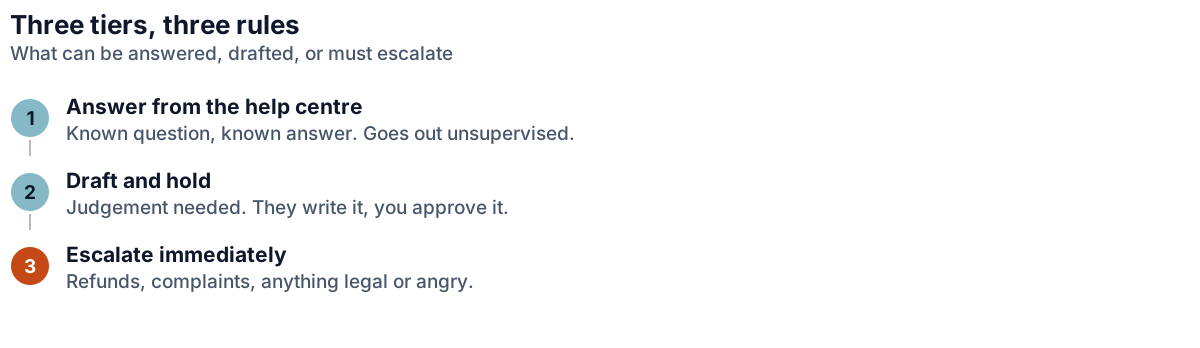
Spend an hour reading the last two hundred support messages and sort them into three tiers. Tier one has a known answer and no judgement: where is my order, how do I reset this, what are your hours, can you resend the invoice. Tier two needs context but follows a pattern, such as a delivery problem or a straightforward complaint about something that plainly went wrong. Tier three is anything involving money moving, a legal implication, a threat to leave, or a customer significant enough that you would want to know.
The proportions surprise most owners: tier one is usually the clear majority of volume and almost none of the risk. Handing over tier one alone typically removes most of the queue while leaving every consequential conversation where it was, which is an exercise in deciding what to delegate first.
Build the Knowledge Base First
Getting the knowledge base right is most of the preparation. It does not need to be elaborate: the twenty most common questions with the approved answer, in one document, is enough to start. This is the same discipline as writing an SOP your assistant will actually follow, and writing it tends to surface the fact that you have been answering the same question slightly differently every time, which is worth knowing regardless of who ends up handling the queue.
A good knowledge base also opens a second option for tier one. A Digital Employee can answer those known questions from the same document while your assistant takes tier two and you keep tier three. It starts supervised, with its replies waiting for approval, and answers on its own once those replies are consistently right; you choose which kinds of message always come to a person.
What a Customer Support Virtual Assistant Handles Well
Given a tiered queue and a decent knowledge base, a customer support virtual assistant handles tier one entirely and drafts tier two for review. They also do something owners rarely think to ask for: they notice patterns. Somebody answering the same question forty times a month is the person best placed to tell you that your checkout page is unclear.
Why Response Time Matters More than you Think?
Response time is where the improvement shows up first, and it matters more than most owners assume. A reply within the hour to a routine question prevents a follow-up message, a second channel attempt, and the escalation of mild irritation into a complaint. Much of what looks like a quality problem in support is a latency problem.
Response templates are worth building together rather than handing down. An assistant who has answered the question fifty times knows which phrasing produces a follow-up question and which one ends the exchange cleanly, and that knowledge should flow back into the templates. Support documentation that only travels in one direction goes stale quickly.
Escalation Rules that Work
'Escalate anything unusual' is not an instruction, because recognising unusual is the whole difficulty. Escalation rules have to be concrete enough to apply without judgement: any mention of legal action, refunds above a stated amount, any customer on a named list, any message where somebody says they are leaving, and anything the assistant has personally not seen before.
That last one matters and is often omitted. A new assistant should escalate freely in the first weeks, and you should treat volume of escalation as a training signal rather than a nuisance. If somebody is punished, even subtly, for escalating too much, they will start guessing instead, and guessing is the failure mode you were worried about when you hesitated to delegate this at all.
Give the assistant a way to record what they were unsure about, separate from the ticket itself. A short weekly list of 'I answered this but I was not certain' is the cheapest quality mechanism available, and it surfaces gaps in the knowledge base far faster than waiting for something to go wrong in public.
Protecting Quality without Reading Every Reply
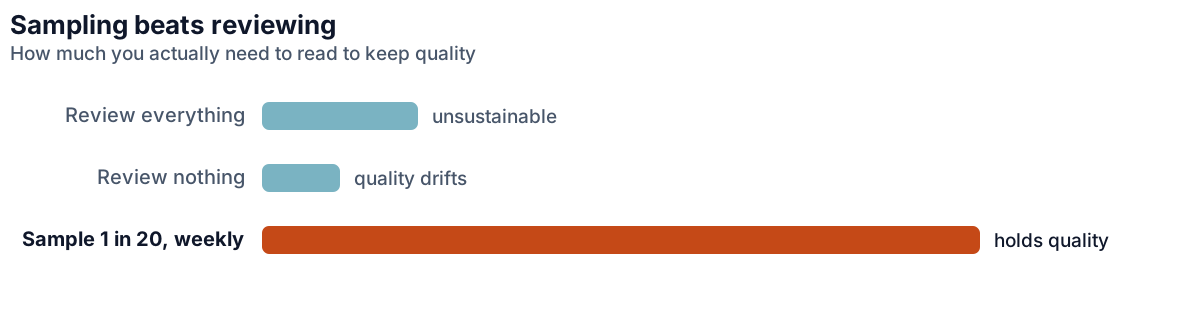
Reviewing every reply defeats the purpose, and reviewing none is how quality drifts unnoticed. The workable middle is a sample: read five random resolved tickets a week for the first month, then five a fortnight. That is enough to catch drift early and small enough that you will keep doing it.
Watch for the specific failure modes rather than general impressions: answers that are technically correct but curt, questions answered without the underlying problem being solved, tickets closed while the customer was still confused. None of those show up in resolution counts, which is why volume metrics alone will tell you everything is fine right up until it is not.
When not to Delegate Customer Support
There are cases where front-line support should stay with you, at least for now. If your product is changing weekly, no knowledge base can keep up and every answer becomes a judgement call. If your customers are few and each one is large, support is account management and belongs with whoever owns the relationship. And if you do not yet know what your common questions are, tiering is guesswork.
That last case is a sequencing problem rather than a permanent one. Handle it yourself for another month while logging what comes in, and the tiers will write themselves from real data. Delegating a queue you have never analysed is how support delegation earns its bad reputation. When you are ready, the same tiering approach applies across the wider set of virtual assistant roles we staff.
Want this handled for you?
We map the work eating your week and match a skilled specialist, typically in 7-14 days.