

Virtual Real Estate Transaction Coordinator: The Complete Guide

A real-estate deal stops being a sales job the moment the offer is accepted. From that point it is a deadline machine: inspection windows, financing contingencies, disclosure timelines, title conditions: each one a date that, missed, can cost the client the house and cost you the commission.
Agents rarely lose deals because they ran out of clients. They lose them because a contingency lapsed while they were standing in someone else's kitchen. That is the specific failure a transaction coordinator exists to remove, and it is worth understanding what the role covers before deciding whether you need one.
What does a Virtual Real Estate Transaction Coordinator do?
A transaction coordinator manages the file from executed contract to closing. They audit the contract for missing signatures and addenda, calendar every contractual date, send and collect disclosures, schedule inspection and appraisal milestones, chase lender conditions, and keep the agent, client, title company and co-op agent informed. The agent stays on selling and negotiating; the coordinator owns the paperwork and the calendar.
A virtual coordinator does the same work remotely, usually supporting several agents' pipelines at once. The distinction that matters is licensure: in most states an unlicensed coordinator can handle administration, documents and scheduling, but cannot give advice, negotiate terms or represent a party. Rules vary, so confirm what your state and brokerage permit before you write the job description.
Transaction Coordinator vs Licensed Assistant
A coordinator is not a licensed assistant. A licensed assistant holds a real-estate licence and can perform activities that legally require one, while a coordinator administers the file: deadlines, documents, disclosures, communication. Plenty of teams run both, and confusing the two is how agents end up either overpaying for admin work or asking an unlicensed coordinator to do something they are not permitted to do.
Contract to Close, in Practice
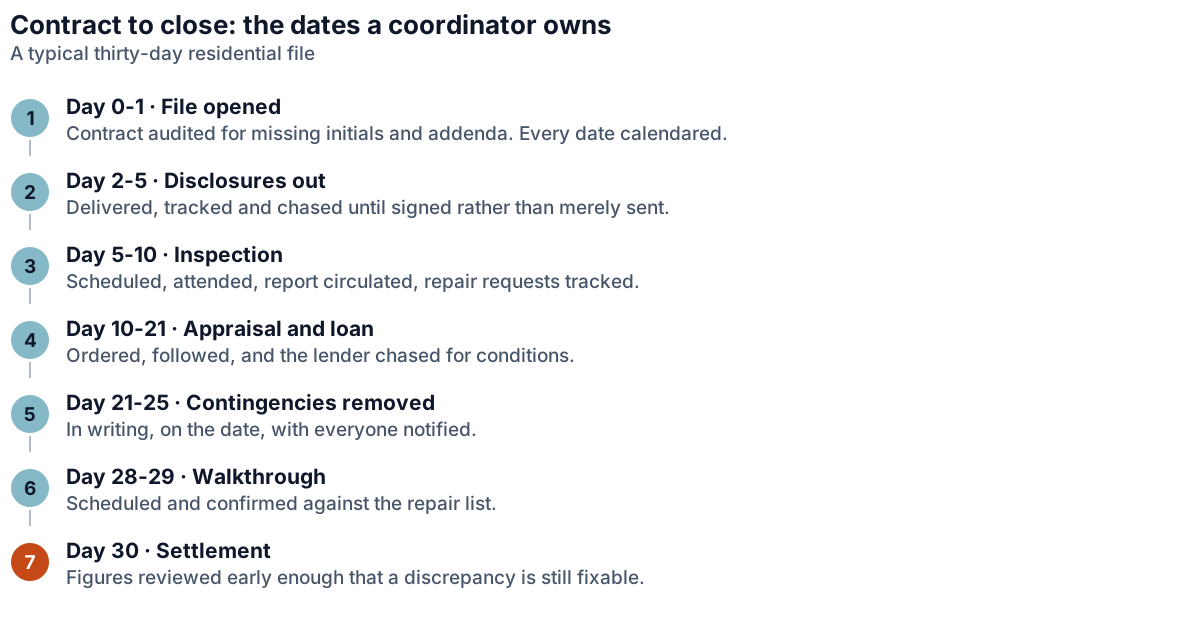
This is the part most articles about hiring a coordinator skip, and it is the part that tells you whether the role is worth paying for. On a typical thirty-day residential file, the work runs like this.
Day 0-1 · File openedThe contract is audited for missing initials, signatures and addenda: the errors that surface later as delays. Every contractual date goes on a calendar, the file is opened in the brokerage system against its compliance requirements, and introductions go out to the client, lender, title company and co-op agent so nobody is guessing who to contact.
Day 2-5 · Disclosures and earnest moneyDisclosures go out and are tracked back rather than assumed. Earnest money is confirmed delivered and receipted, the inspection is scheduled with access arranged, and the lender's file is checked for completeness: because an incomplete lender file discovered in week three is a deadline problem, while the same gap found in week one is an email.
Day 5-14 · Inspection and appraisalInspection reports are distributed and the repair negotiation is tracked. The appraisal is confirmed ordered and then followed to result. Outstanding lender conditions get chased continuously in this window, which is where most preventable delays get headed off.
Day 14-30 · Contingencies and closingContingency removals are tracked against the calendar, title and payoff items coordinated, the final walkthrough scheduled, and the settlement statement reviewed for errors before anyone signs. After closing the compliant file is archived and post-close follow-up is triggered, the step that quietly generates repeat business and is almost always the first thing dropped when an agent self-coordinates.
Virtual, In-House, or do it Yourself
The right answer depends on deal volume and on what an hour of your time is worth. Below roughly two transactions a month, coordinating them yourself is defensible. Above that, the question stops being whether you can afford a coordinator and becomes what a lapsed contingency costs you.

| You do it | In-house TC | Virtual TC | |
|---|---|---|---|
| Cost model | "Free" - paid in selling hours | Salary + payroll tax + benefits + equipment | Setup fee + monthly service fee |
| Works well at | Under ~2 deals/month | High, steady volume | Variable or growing volume |
| Ramp time | None | Hiring cycle, then training | Days, if they arrive trained |
| Cover when absent | n/a | You cover it | Managed, backup and replacement |
| Main risk | Missed dates during listing appointments | Fixed overhead through slow months | Weak fit if hired on price alone |
What it Costs
Pricing takes two common shapes. Per-file pricing charges for each transaction coordinated and flexes naturally with volume, which suits agents whose deal flow is uneven. A managed monthly engagement assigns a dedicated coordinator to your pipeline continuously, which buys consistency and someone accountable for coverage when the coordinator is unavailable.
When comparing against an employee, compare the whole cost rather than the salary line: payroll taxes, benefits, equipment, software seats, management time, and the ramp period before productivity. Our breakdown of a virtual assistant versus an in-house employee runs the full arithmetic. HireTrainVA works on the managed model: a one-time setup fee covering scoping, sourcing and vetting, then a monthly service fee billed in advance.
Tools they should Already Know
A coordinator who must be taught your stack is a coordinator you are training rather than delegating to. Your brokerage typically dictates the transaction platform, so confirm compliance requirements before deciding what fluency is non-negotiable.

Fluency matters more than breadth here. A coordinator who knows one transaction platform well will learn yours in days, whereas someone who has only watched a tutorial will quietly slow every file down while appearing competent in the interview. Ask candidates to describe how they would set up a file in the system you use, the answer separates real experience from a list of tools on a CV very quickly.
- Dotloop
- SkySlope
- Brokermint
- DocuSign
- Follow Up Boss
- kvCORE
- Google Workspace
Signs you have Passed the Threshold
Most agents wait longer than they should, usually because the cost is visible and the loss is not. These are the signals that the arithmetic has already changed, and they echo the broader signs you are ready for a virtual assistant.
The waiting has a cost. An hour spent chasing a lender condition is an hour taken from the activity that generates the next commission, plus the risk that something further down the file gets missed while your attention is elsewhere. Once two or three of the signals below are true at the same time, the coordinator is almost certainly cheaper than continuing to absorb the work yourself.
- You are consistently closing two or more transactions a month
- You have checked a contingency date from your car more than once
- Paperwork routinely happens at night or at weekends
- You have delayed prospecting because a file needed chasing
- A deadline has slipped, or nearly slipped, in the last quarter
Onboarding a Coordinator
Coordinator relationships usually succeed or quietly fail in the first fortnight, and for the same reason as any other delegation: the role was never bounded. Define precisely which files they own, grant system access before day one, hand over your contract templates and compliance requirements, and start with a small number of live files under review before releasing the pipeline.
The full day-by-day version is in our ten-day onboarding plan. If you are weighing coordination alongside broader support, lead follow-up, listing admin, CRM hygiene, see how we staff virtual assistants for real-estate teams.
Want this handled for you?
We map the work eating your week and match a skilled specialist, typically in 7-14 days.