

Inside Sales Agents and Cold Callers for Real Estate

Cold calling has a reputation problem in real estate, and most of it is deserved, because of how outbound usually gets staffed: the agent does it when the pipeline looks thin, stops when it fills up, and concludes six weeks later that calling does not produce results. The activity was never consistent enough to produce anything.
An inside sales agent exists to remove that inconsistency. It is the least glamorous hire in real estate and frequently the highest-leverage one, because it converts prospecting from something you do when you have time into something that happens whether or not you do.
What a Real Estate Inside Sales Agent does
An ISA works the top of the funnel so the agent can work the bottom of it. They call new and aged leads, follow up on enquiries that never got a second touch, qualify interest against real criteria, and book appointments into the agent's calendar. It is lead generation and qualification combined, and the output is qualified conversations that turn into appointments that turn into listings.
The distinction between an ISA and a cold caller matters more than the titles suggest. A cold caller dials lists and hands over anyone who answers. An ISA qualifies, handles the first objection, keeps a long-cycle lead warm for months, and knows when a conversation is worth escalating to you. The second role costs more and is worth considerably more, because unqualified appointments waste the most expensive hour in the business: yours.
The Numbers that Matter
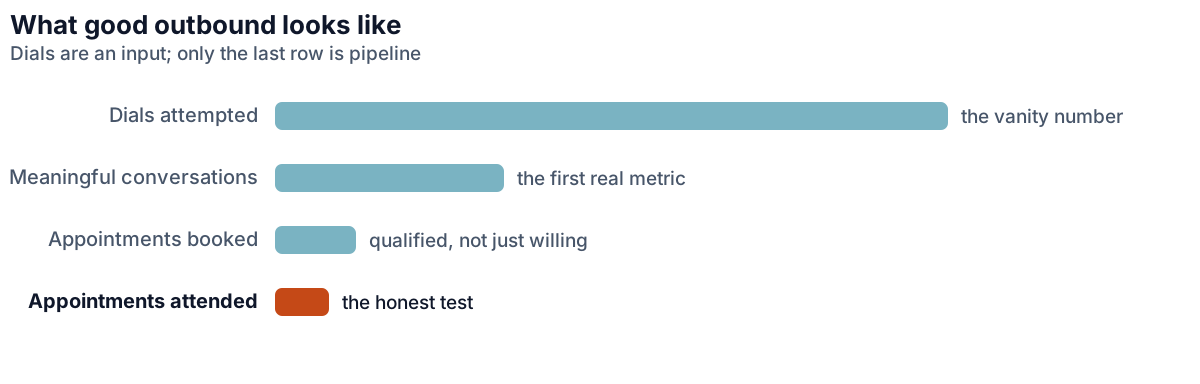
Most agents measure the wrong thing. Dials are an input, and an ISA optimising for dials will produce a large number of very short conversations. The metrics worth watching describe whether the activity is turning into pipeline, and they mirror the ones behind any good appointment setter.
- Conversations per day - meaningful contacts, not dials attempted
- Contact-to-appointment rate - how many conversations become a booked slot
- Appointment show rate - the clearest test of qualification quality
- Speed to first touch - minutes, not hours, on inbound enquiries
- Database touches - whether aged leads are being worked
Show rate is the one that exposes problems fastest. An ISA booking plenty of appointments that nobody attends is producing calendar entries rather than pipeline, and the difference will not appear in a dials report. It is the same lesson as why show rate beats booking volume for any setter.
Speed to First Touch is the Cheapest Win
Speed to first touch deserves its own mention, because it is the cheapest improvement available to most teams. An enquiry answered within minutes converts at a materially different rate to the same enquiry answered the following morning, and the gap comes down to whether somebody was assigned to respond. That single habit often justifies the role before any cold calling happens at all.
Why Scripts Matter More than Personality?
There is a persistent belief that outbound success comes down to whether someone is naturally good on the phone. Confidence helps, but consistency is what compounds. A structured script gives the caller a reliable opening, a qualification path, and a defined response to the four or five objections that account for most of what they will hear.
Scripts also make coaching possible. When every call follows a recognisable shape, you can listen to three recordings and identify precisely where conversations are dying: the opening, the qualification, or the ask. Without that structure, feedback degrades into "be more natural," which is not something anyone can act on.
Hiring One Who Lasts
Turnover is the real cost in this role. Replacing an ISA every few months means permanently paying the ramp cost and never reaching the point where the person knows your market well enough to handle nuance. Two things drive most of the churn: hiring on hourly rate, and giving no path beyond dialling.

The rate problem is straightforward arithmetic. A cheaper caller who books unqualified appointments costs you the appointment time plus the trust of the lead, and that is more expensive than the hourly difference. The second problem is subtler, an ISA who sees no progression treats the role as temporary and behaves accordingly.
- Define the role as pipeline ownership, not phone duty
- Test on a live call during hiring, not just an interview
- Provide scripts, objection handling and a CRM that is kept current
- Review recordings weekly for the first month, then spot-check
- Tie part of the compensation to appointments that show, not calls made
The Stack an ISA Needs
An ISA without a functioning CRM is doing expensive guesswork. The single biggest determinant of whether outbound produces anything durable is whether every conversation is logged somewhere the next conversation can build on. Dialer choice matters far less than that discipline.
- Follow Up Boss
- kvCORE
- Sierra
- Power dialer
- Google Workspace
- Slack
When an ISA is the Wrong Hire
Not every agent needs one. If you have fewer than a few hundred contacts in the database and no consistent lead source, an ISA will spend their day calling a list that cannot support the activity. The bottleneck in that case is lead supply, and hiring a caller will not fix it.
The role starts making sense when you have leads going cold because nobody follows up, a database large enough to work systematically, and enough appointment capacity to absorb what a full-time caller produces. If your calendar cannot take five more appointments a week, adding an ISA creates a queue rather than revenue.
Managed versus Hiring Direct
Hiring an ISA yourself means owning recruitment, screening, training, scripts, quality control and replacement when they leave. That is a heavy operational load, and it lands on the person who least has time for it: which is why so many ISA programmes quietly stop after the first departure.
A managed engagement moves the recruitment and replacement risk off your desk. At HireTrainVA the specialist is screened and already skilled before they reach you, a dedicated account manager oversees performance, and every match carries a two-week replacement guarantee. The trade-off is a monthly fee against fixed headcount overhead, which flexes with your volume rather than persisting through slow quarters.
If your bottleneck is further down the funnel, our transaction coordinator guide covers the contract-to-close side, and you can see how we staff virtual assistants for real-estate teams.
Want this handled for you?
We map the work eating your week and match a skilled specialist, typically in 7-14 days.