

Virtual Assistants for E-Commerce: Where the Hours Actually Go

Why E-Commerce Stores Hire Virtual Assistants?
Most e-commerce owners start out believing their time will go into product, brand and marketing. In practice, once volume arrives, it goes into exceptions: the order that did not ship, the customer who wants to change an address after dispatch, the return that arrived without a reference, the listing that needs updating because a supplier changed a specification. This is the gap virtual assistants for e-commerce are built to close.
None of that is strategic and all of it is urgent, which is the worst possible combination for an owner's calendar. It also scales linearly with orders, so the busier the store gets, the less time exists for the work that made it busy. Flexible support is good at getting a store out of that trap, because almost all of it is process rather than judgement.
Customer Support is Most of the Work
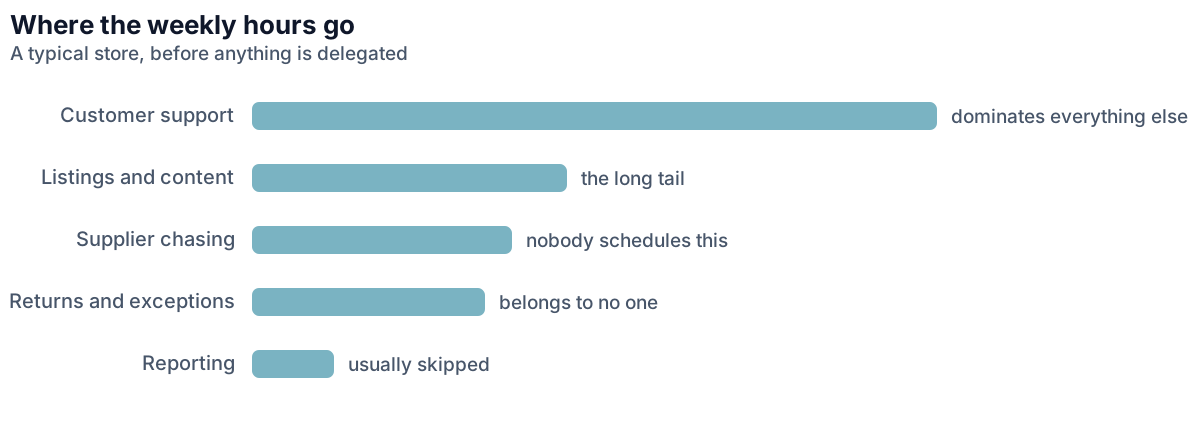
In most stores, support is the single largest consumer of hours and the highest proportion of it is repetitive: where is my order, can I change my address, how do returns work, is this in stock, what size should I buy. Those have known answers, and they arrive constantly. A customer support virtual assistant can take almost all of it.
An assistant handling front-line support changes the day in two ways. The obvious one is volume removed. The less obvious one is response time: a store answering within the hour generates fewer follow-up messages, fewer chargebacks, and fewer marketplace disputes than one answering the next day, because much of what escalates does so through silence rather than through the original problem.
Marketplace metrics make this concrete in a way that is unusual across industries. Response time and defect rate feed directly into seller ratings and search placement on most platforms, so slow support measurably suppresses sales as well as annoying customers. The same tiering and escalation approach that works for any support queue applies here.
Order Exceptions that Fall between Teams
Order exceptions sit between support and fulfilment and belong to neither cleanly, which is why they end up with the owner. Address changes after dispatch, split shipments, items damaged in transit, carrier claims, and orders flagged by fraud screening all follow known paths in most stores. Writing those paths down converts a stream of judgement calls into process somebody else can run.
Listings, Content and the Long Tail
Listing work is the other large block, and it is chronically deferred because nothing breaks immediately when it slips. Product descriptions, images, variant setup, categorisation, attribute completeness, translations, and keeping information consistent across a website and two or three marketplaces where each has different requirements.
The compounding effect here runs the other way from support. Incomplete or inconsistent listings suppress conversion and search placement quietly and permanently, and nobody sends you a message about it. An assistant working steadily through a listing backlog produces improvement that is invisible week to week and substantial over a quarter, which is the kind of work a busy owner never gets to.
Suppliers, Stock and Returns
Supplier coordination is unglamorous and expensive to neglect. Chasing purchase orders, confirming lead times, updating stock levels, flagging items about to go out of stock, and reconciling what arrived against what was invoiced. An out-of-stock listing that stays live costs a sale and a poor customer experience simultaneously; an unnoticed short delivery costs money directly.
Returns processing sits alongside it and follows a strict process in almost every store, which makes it delegable in full: receiving, inspecting against policy, restocking or writing off, issuing the refund or replacement, and updating the customer. The exceptions, a policy call, a fraud pattern, a customer worth keeping despite the rules, escalate to you, and they are a small fraction of the volume.
Planning for Seasonal Peaks
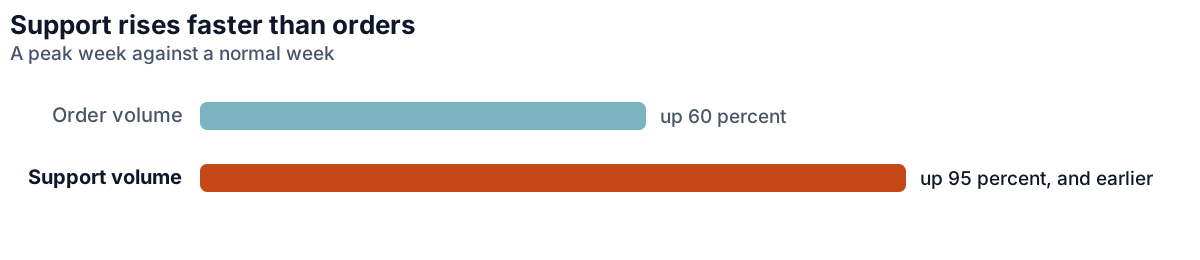
E-commerce volume is rarely flat, and the peaks are known well in advance. Support volume rises faster than order volume during a peak, because the same percentage of problems applies to a larger number and because customers are more anxious about delivery timing when a date matters to them.
Plan capacity from support volume rather than from order volume, and put it in place several weeks before the peak rather than during it. The pattern that fails is hiring in late November: the assistant is learning your policies during the week when getting them wrong is most expensive and most visible.
Reporting is the piece most owners never delegate and probably should. A weekly summary of orders, returns by reason, support volume by category and stock about to run out takes an assistant under an hour once it is templated, and it replaces the vague sense of how the week went with something you can act on. Returns by reason in particular tends to expose a product or listing problem that has been quietly costing money.
The Number that Tells you it is Time
The most useful metric is support contacts per hundred orders. Track it for a month and it tells you two things at once: whether you have an operations problem, and whether an assistant will fix it. A high ratio usually points at something upstream, unclear delivery expectations, a sizing guide people cannot find, a shipping option that misleads, and that is worth fixing before adding capacity to absorb the consequences.
If the ratio is reasonable and the absolute volume is large, that is a capacity problem and it delegates cleanly. If the ratio is climbing, adding support hours treats the symptom. The number is cheap to collect and it distinguishes between two situations that feel identical from inside a busy week. When the answer is capacity, see how we staff e-commerce teams with trained assistants.
Want this handled for you?
We map the work eating your week and match a skilled specialist, typically in 7-14 days.