

Virtual Assistants for Healthcare Practices: The Compliance-First Guide

Why Compliance Comes First for Healthcare Virtual Assistants?
In most sectors you can define the role and address the controls in parallel. In a healthcare practice that order is reversed, because the framework governing patient information determines what the role can be at all. Getting this wrong carries regulatory and financial consequences that dwarf any efficiency gained. It is the one thing that sets virtual assistants for healthcare practices apart from every other placement.
What follows is a practical orientation, not legal advice, and the specifics vary by state and by practice type. Confirm your position with your compliance officer or counsel before engaging anyone. Practices that read that sentence as a routine disclaimer are the ones that discover a problem later.
The Business Associate Agreement is the Gate
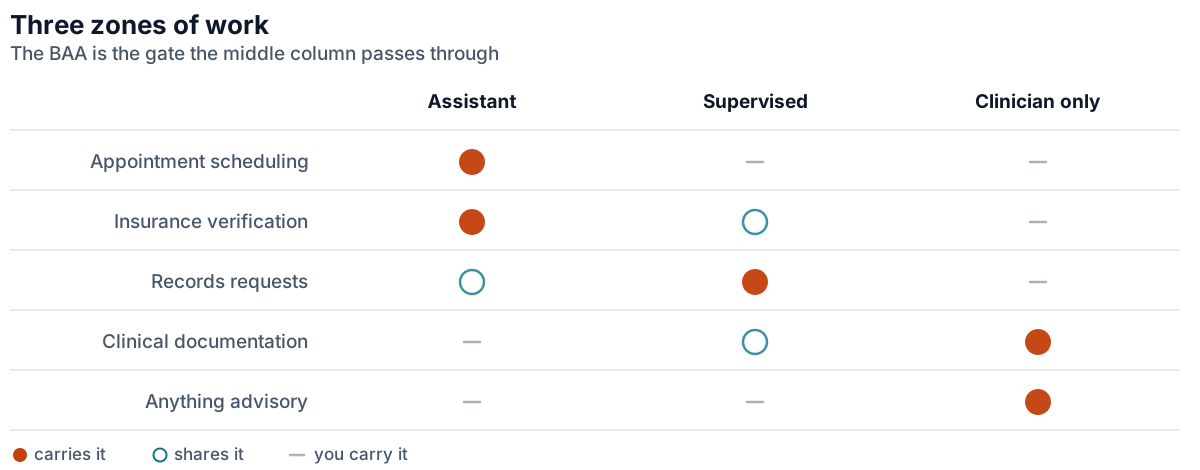
Under HIPAA, anyone outside your workforce who handles protected health information on your behalf is generally a business associate, and that relationship requires a written business associate agreement before any such information is shared. This applies regardless of whether the person is a contractor, an agency, or an individual assistant working remotely.
In practice, the BAA is the gate the engagement passes through first. A provider who cannot or will not sign one, or who does not know what you are asking for, has answered your question about whether they are equipped for healthcare work. Ask early and treat the answer as diagnostic.
Training deserves more weight here than in other industries. An assistant working in a practice needs to understand not only the tasks but why the boundaries exist, because the situations that test them arrive unannounced and by telephone. Practices that invest a day in that understanding get somebody who recognises the edge of their role in the moment; practices that skip it get somebody trying to be helpful in a situation where helpfulness is the risk.
What a Non-Clinical Healthcare Virtual Assistant Handles
With the framework in place, the administrative load a practice carries is substantial and largely transferable. Appointment scheduling, confirmation and reminder calls, waitlist management, insurance eligibility verification, prior authorisation follow-up, claim status chasing, patient billing enquiries, records requests, referral coordination, and the endless task of chasing payers for answers. Most of it maps onto standard administrative assistant work, wrapped in a compliance layer.
Insurance Follow-Up: Where Money Leaks
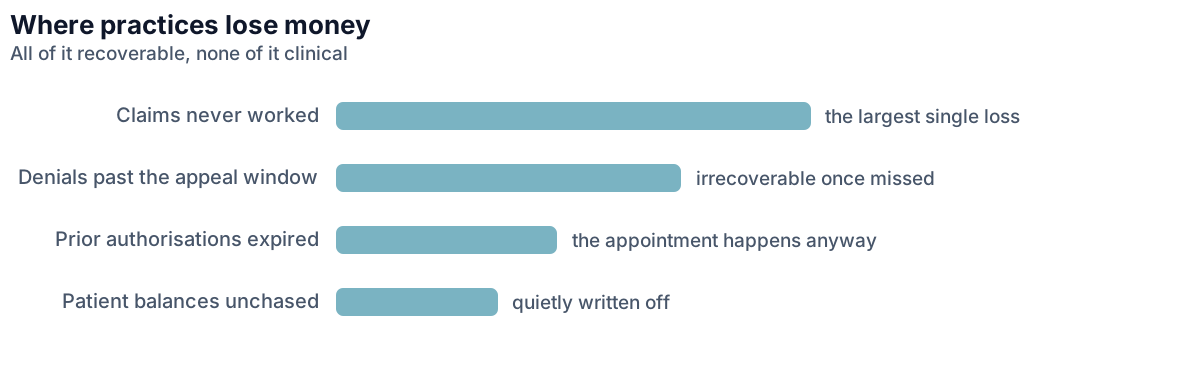
Insurance follow-up deserves particular attention because it is where practices lose money quietly. Claims sit unworked, denials go unappealed past their window, and prior authorisations expire: not through incompetence but because chasing payers is tedious, time-consuming and always less urgent than the patient in front of you. An assistant whose job is that chasing frequently recovers more than the engagement costs.
The Clinical Line, Which does not Move
A non-clinical assistant does not give clinical advice, does not triage symptoms, does not interpret results, does not make decisions about care, and does not perform any function requiring a clinical licence. This holds regardless of how experienced or capable they are, and regardless of how obvious a particular answer might seem.
The boundary needs to be explicit rather than assumed, because patients do not respect it: somebody calling to reschedule will often describe a symptom and ask whether it sounds serious. Your assistant needs a clear script for that moment and the confidence that using it is correct rather than unhelpful. Practices that leave this to judgement put an untrained person in a position they should never occupy, and it is your responsibility to prevent that rather than theirs to navigate.
Telephone manner is its own competence in this setting and worth testing before placement. Patients calling a practice are frequently anxious, occasionally distressed, and sometimes calling about something they find embarrassing. An assistant who is efficient but brisk will generate complaints that never reach you directly, they show up as patients quietly moving elsewhere.
Access and the Minimum Necessary Standard
HIPAA's minimum necessary standard is a useful design principle beyond its regulatory force: limit access to the information required for the specific task rather than granting whatever is convenient. Practice management systems generally support role-based permissions that make this straightforward if you configure them deliberately, and the broader discipline of giving an assistant access safely applies with extra force here.
Alongside that, the practical controls are unglamorous and effective. Named individual logins, never shared. Two-factor authentication everywhere it is supported. Audit logging enabled and occasionally reviewed rather than merely switched on. A written policy on how patient information may be transmitted, which in practice means through your systems rather than by personal email or messaging. Documented offboarding so access is removed promptly when an engagement ends.
Documentation of the arrangement matters as much as the arrangement itself. Written policies on what the assistant may access, a record of the training they received, a signed agreement, and evidence that access was removed at the end are what demonstrate diligence if anybody ever asks. Practices are used to keeping records of clinical process; applying the same instinct to administrative support is straightforward and rarely done.
Where the Value Shows up
Practices generally expect the benefit to be front-desk relief, and that is real. The larger effect is usually on the revenue cycle, because that is where deferred work converts directly into lost money. An unappealed denial is revenue you earned and did not collect, and appeal windows close whether or not anybody had time.
The second effect is on patient experience, which is harder to measure and easier to feel. Calls answered rather than sent to voicemail, reminders that go out, and referrals that get followed up all change how a practice is perceived, and they are the things that slip when the front desk is one person short during a busy clinic. If that is your practice, see how we staff compliant virtual assistant roles around the clinical line.
Want this handled for you?
We map the work eating your week and match a skilled specialist, typically in 7-14 days.