

Virtual Assistants for Law Firms: The Boundaries That Make It Work

The Economics of a Virtual Assistant for a Law Firm
A lawyer doing administrative work is the most expensive administrator any business employs. Every hour spent chasing a signature, formatting a document, updating a matter record or booking a deposition is an hour not billed, and in a small firm those hours accumulate into something close to a second job that generates no revenue. That is the case for virtual assistants for law firms in a single sentence.
What makes this worth addressing carefully rather than quickly is that legal work sits inside a professional framework the rest of business does not have. Confidentiality is a professional duty, conflicts carry real consequences, and there are things a non-lawyer may not do regardless of how capable they are. The firms that get value here treat the boundaries as the design constraint rather than as friction.
Where the Line Sits: Unauthorised Practice of Law
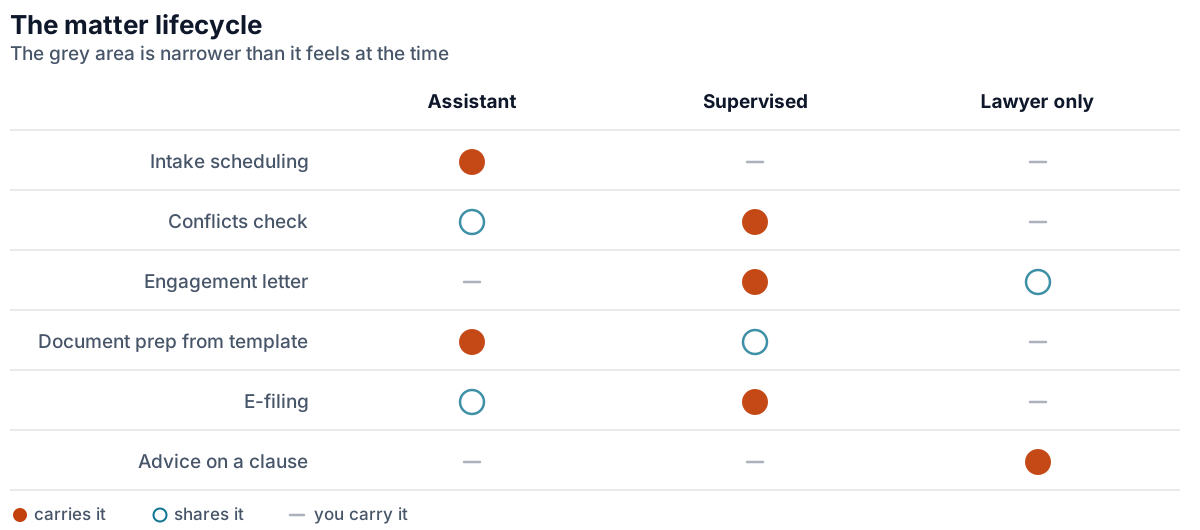
The prohibition on the unauthorised practice of law is the governing constraint, and its exact scope varies by state, so treat what follows as orientation rather than as a ruling. In broad terms a non-lawyer must not give legal advice, must not exercise independent legal judgement, must not set fees, must not accept a matter on the firm's behalf, and must not represent a client in any proceeding.
Where it gets practical is in the grey area that arises daily. A client calls and asks what a clause means, or whether they should sign something, or what happens next in their case. The last of those is often answerable as process; the first two are not. Your assistant needs an explicit script and the confidence that deflecting is correct rather than unhelpful, and they need to know that 'I will have the attorney call you back' is always a safe answer.
What a Legal Virtual Assistant Handles
Once the boundary is clear, what remains is substantial. Intake scheduling and gathering the information a lawyer needs before a first conversation. Document preparation from firm templates. E-filing and court portal submissions where permitted. Calendar and deadline management including court dates. Client communication about status, appointments and requirements. Records requests. Matter file organisation. Billing preparation and receivables chasing. Most of it is administrative assistant work held to a higher standard of care.
Deadline Management: A Malpractice Risk if it Slips
Deadline management deserves emphasis because the consequences of failure are categorically different in this industry. A missed limitation date or filing deadline is a malpractice exposure rather than an inconvenience. Handing calendaring to somebody whose actual job it is, with redundancy, reminders and a single authoritative view, usually reduces risk rather than adding it, which is the opposite of what most partners assume when they first consider it.
Billing preparation is worth separating out because it addresses a specific and common failure. Time that is not recorded promptly is recorded inaccurately or not at all, and firms routinely write off hours that were worked. An assistant chasing time entries, assembling drafts and running the invoicing cycle recovers revenue that already existed rather than generating new work.
Confidentiality is the Design Constraint
Client confidentiality obligations extend to everyone the firm engages, and the arrangement has to be built so that compliance is structural rather than dependent on somebody remembering. That means written confidentiality undertakings, access scoped to the matters a person works on rather than the whole system, named individual logins, and document handling that stays inside firm systems rather than personal email or consumer file-sharing. This is the discipline of giving an assistant access safely, applied to privileged material.
Check your state bar's guidance on outsourced support and on supervision of non-lawyer assistants, and check whether client engagement terms require disclosure of third parties working on a matter: some do, and some clients ask specifically. Firms that raise this proactively find it a short conversation; firms that do not raise it discover the question at an awkward moment.
Conflicts and Intake
Intake is where an assistant adds obvious value and where a specific risk lives. Gathering contact details, the nature of the enquiry, the parties involved and the basic facts is straightforward, saves the lawyer a great deal of time, and produces a better first conversation.
The risk is that a prospective client, mid-enquiry, will start disclosing detail, and an enquiry that turns out to conflict creates a problem the moment that information is received. Assistants doing intake need to run or trigger the conflicts check early, capture the parties before the narrative, and know how to pause a caller who is volunteering more than the process needs. That sequencing is a small procedural detail with disproportionate consequences.


E-filing rules deserve checking specifically, because they vary by court and by jurisdiction. Some systems require the filer to be an attorney of record; others permit a designated staff account. This is a five-minute question with a definite answer, and it is worth resolving before somebody attempts a filing rather than at the point a submission is rejected.
Supervision is not Optional
Non-lawyer assistants work under lawyer supervision, and that is a professional responsibility rather than a management preference. In practice it means a named supervising lawyer, work that is reviewed rather than assumed, and clarity about which tasks may proceed without sign-off and which may not.
The practical form this takes is unglamorous: a documented list of what the assistant may do unsupervised, a review step on anything going to a client or a court, and a standing point of contact for questions so that nobody is guessing. Firms that formalise this find delegation straightforward. Firms that leave supervision implicit tend to oscillate between over-checking everything, which wastes the lawyer's time, and checking nothing, which is where the risk lives. When the framework is set, see how we staff supervised virtual assistant roles for firms.
Want this handled for you?
We map the work eating your week and match a skilled specialist, typically in 7-14 days.